1. At a glance
What each extension does to what the model is sent, and so to the gates:
flowchart LR
    a["A tool<br/>A Petrophys function<br/>A guide of the packaged library<br/>The report style's zone table"] --> sent["What the model is sent changes:<br/>measure, then re-record live"]
    b["A figure kind"] --> mini["The mini set's figures call<br/>can change: re-record live"]
    c["A model card of your own<br/>A library of your own<br/>A setting left at its default"] --> nogate["No gate changes"]
    d["A behaviour change"] --> switched["A switch, off by default:<br/>gates pass unchanged,<br/>measure, adopt or drop"]
| Extension | Where it goes | Tests to run | Changes what the model is sent |
|---|---|---|---|
| A tool | src/ (+ its function, + C4 description) |
tests/, tests/, tests/test_lint.py, tests/ |
Yes, on every question (the brief lists every tool) |
| A Petrophys function | Petrophys itself, with its parameter declarations; PACKAGES in src/ for a new package |
tests/ |
Yes: each verb's description counts and groups its functions |
| A skill guide or library | src/ or a folder of your own |
tests/, tests/, tests/, tests/, tests/test_lint.py |
Yes for the plugged library (the index, and a guide when it is read) |
| A report style | src/, named by reporting.profile in the policy |
tests/, tests/test_lint.py |
Only through format.zone_table |
| A model card | src/, or any YAML file |
tests/ |
Only for runs that use the card |
| A figure kind | DISPLAYS in src/ (+ the plot in Petrophys) |
tests/, tests/ |
The figures call of a conversation, when the display is offered |
| An interpretation setting | src/ (+ config.DataPaths for a zone-rule setting) |
tests/ |
Only when a run sets it |
| A dataset config | configs/, or a file PETROHARNESS_DATA names |
tests/test_lint.py, the data tests |
Only through data.basis and data.conventions |
| A component text | a file and a texts line in src/ |
tests/ |
Yes, wherever a prompt holds it |
| A behaviour change | Options in src/, read where the behaviour lives |
tests/, every gate with the switch off |
Only with the switch on |
2. How it works
flowchart TD
    a["What does the change touch?"] --> p{"A calculation,<br/>a method or a plot?"}
    p -- "yes" --> petro["Petrophys first,<br/>then the harness line that offers it"]
    p -- "no" --> h["Harness files<br/>named by the recipe"]
    petro --> t["Tests of the recipe"]
    h --> t
    t --> m{"Meant to alter what<br/>the model is sent?"}
    m -- "no" --> g["Gates must pass unchanged"]
    m -- "yes" --> s["Switch, off by default"]
    s --> g2["Gates pass with the switch off"]
    g2 --> e["Measure end to end"]
    e --> ad{"Adopt?"}
    ad -- "yes" --> rr["Make it the code,<br/>remove the switch,<br/>re-record live"]
    ad -- "no" --> rm["Remove it"]
- Place it. Calculations, methods and plots go into Petrophys; the harness coordinates, records and checks (AGENTS.md rules 3 and 4; CONTRIBUTING.md, "Where a contribution goes").
- Write it in the files the recipe names. No dataset names or depth literals in code, rules or prompts
(
tests/test_lint.py); every fixed model-facing text inside a component (src/).petroharness/ agent/ components/ - Test it with the recipe's tests, then the fast suite and the public mini set (Testing).
- Not meant to alter what the model is sent: run every gate you can; a difference is the bug.
- Meant to: put it behind a switch (
options.py, off by default), show the gates pass with it off, measure it end to end against a control run (AGENTS.md rule 8), and adopt or drop it. - On adoption the switch and its branch go, and the gates are re-recorded live in the same change; a change to what is done with the replies only is re-recorded by replay (section 13).
3. Add a tool
A tool of the harness itself (a lookup of the record, a computed table, an object of a verb) is one Tool in
src/; every list of tools is read from it.
# src/petroharness/agent/toolset.py, in TOOLSET.add(...), under its group
Tool("adjacent_jumps", K.adjacent_jumps, CHECK, _text("adjacent_jumps"),
     {"curve": CURVE, "threshold": {"type": "number"}, "zones": ZONES},
     ("curve", "threshold"), main="curve", lead="curve", table=True),
- The function. A lookup of the record:
src/. A computed table: a functionpetroharness/ agent/ tools. py (view, **args) -> dictinCATALOG(src/) and a wrapper inpetroharness/ record/ catalog. py src/that callspetroharness/ agent/ compute. py _. An object of a verb over Petrophys: the verb's module (run(f, "<name>", zones, **args) agent/library/). Petrophysics is computed only by Petrophys (AGENTS.md rule 4). - The description.
"<name>": "<text>"insrc/, which holds every tool's description;petroharness/ agent/ components/ C4_ tools/ tool_ descriptions. json agent.reads it.toolset. _ text(name) - The definition. A
Tool(...)inTOOLSET.add(...)under its group (agent.); the order of definition is the order in the brief.toolset. TOOLSET - Argument reading (nothing to add). Each argument is read as its schema types it (
agent.):schemas. kinds integerornumber(a number sent as text is read as one), an array of strings (one name as text is a list of one),string(text sent as a list of one is that text) andboolean("true"and"false"written as text are flags). An example for a refusal's text can be added to_LISTSor tosrc/.petroharness/ agent/ components/ C4_ tools/ argument_ texts. json - A generic data operation (when it does not reach Petrophys). A
CATALOGcomputation that is a generic data operation, not petrophysics, is listed inGENERICoftests/with its reason.test_ petrophys_ integration. py - Tests.
tests/checks the definition automatically, andagent/ test_ tool_ registration. py tests/the tool reference's master table: refresh it withtest_ docs_ tables. py .. Add a test of the tool's output: offline on stub or synthetic data where possible, or withvenv/ bin/ python tests/ docs_ tables. py --write @pytest.mark.databesidetests/andagent/ test_ b2_ compute. py tests/.agent/ test_ tool_ lines. py - Gates. The brief changes on every question: the mini set, the golden tapes, the prompt fixture and the request gate all differ. Measure, then re-record live (section 13; AGENTS.md rule 7).
The tool above, called on the Brent Group of GeoLink 30/6-5 as {"adjacent_:
Adjacent-sample changes of DTC larger than 10 us/ft: each zone, the zones pooled, the whole interval
  Z1 | lithology: SAND | depth (m): 2841.3–2845.7 | changes beyond threshold: 0 | largest |change|: 4.14
  […]
  Z19 | lithology: SAND | depth (m): 2951.7–2955.0 | changes beyond threshold: 1 | largest |change|: 10.74
  Z20 | lithology: SILT | depth (m): 2955.2–2957.9 | changes beyond threshold: 0 | largest |change|: 4.037
- threshold 10 us/ft (your threshold)
- zones pooled: largest adjacent change 10.74 us/ft at 2952.3–2952.4 m; 1 changes exceed 10 us/ft: 2952.3–2952.4 m (10.74)
- whole interval (201 samples outside any zone): largest adjacent change -13.75 us/ft at 2862.2–2862.4 m; 3 changes exceed 10 us/ft: 2862.2–2862.4 m (-13.75); 2862.4–2862.5 m (-11.67); 2952.3–2952.4 m (10.74)
The Tool definition
| Name | Type | Default | Meaning | Defined in |
|---|---|---|---|---|
name |
string | required | As the model writes it: {"<name>": {...}}. Letters, digits and _, unique. |
tools.spec.Tool, Toolset.add |
run |
callable | required | run(formation, **arguments) -> Result. |
tools.spec.Tool |
group |
string | required | The brief's heading it is listed under: DESCRIBE, COMPARE, CHECK, CALCULATE, CLASSIFY, SUMMARIZE or CALIBRATE (the constants of toolset.py). |
agent.toolset, Toolset.add |
description |
string or callable | required | The text the model reads; a callable is built when asked. | tools. |
arguments |
dict or callable | {} |
Argument name to JSON schema, in the order the brief lists them. | tools. |
required |
tuple | () |
The arguments a call must give; each must be in arguments. |
Toolset.add |
main |
string | "curves" |
The argument a bare value fills: {"runs": "NET_ is {"runs": {"condition": "NET_; must be in arguments when the tool defines any. |
Toolset.main, Toolset.add |
lead |
string | "" |
The argument a one-line listing leads with (runs NET_); must be in arguments. |
Toolset.lead, ledger. |
table |
boolean | False |
Its result is a computed table (header, rows, facts) and is read in that order. | ledger, direction |
verb |
boolean | False |
A verb over Petrophys: it also takes search, run, args and label (built by toolset._verb). |
agent. |
Toolset.addchecks every definition when the harness is imported and raises a WHAT / FIXValueErrorfor a name that is not an identifier, a name defined twice, a group the brief does not list, nothing to run, an empty description, a required argument it does not define, amainit does not define (when it defines any argument), or aleadit does not define.- The shared argument schemas are
ZONES,WHERE,STATS,CURVEandCURVESintoolset.py.
Tests and notes for a tool
.venv/bin/python -m pytest -o addopts= -q tests/agent/test_tool_registration.py tests/test_petrophys_integration.py \
    tests/test_generality.py
PETROHARNESS_DATA=/path/to/data.yaml .venv/bin/python -m pytest -o addopts= -q tests/test_lint.py
.venv/bin/python -m pytest -o addopts= -q tests/gate        # expected to fail: the brief changed
test_fails when the schema shows an argument the function does not take (every_ definition_ is_ whole Tool.parameters()), so the model is never shown an argument that would be ignored.- The description is model-facing text: no benchmark words, no conclusion forms, no preference phrases
(
tests/), no depth literals or dataset names (test_ generality. py tests/test_lint.py). toolset.py,tools/spec.py,agent/schemas.pyandagent/engine/are C4 frames, andagent/tools.pyandagent/compute.pyC7 frames, so editing them changes those components' versions (Testing).Toolhas no switch field: the brief lists every defined tool. Measuring a tool before adoption needs a code path that reads a switch (section 12).
How the tool appears in the tool list
The definitions feed the brief, the native schemas, the reply parser, the ledger and the web UI.
| Name | Type | Meaning | Defined in |
|---|---|---|---|
| The brief's tool text | text | C4's library line, then each group heading ( <GROUP>), each tool as {"<name>": {"<arg>": ..., ...}} <description>, then the zone selector line. |
agent., replies.VERBS |
| Native schemas | list | {"type": "function", "function": {"name", "description", "parameters": {"type": "object", "properties", "required"}}} per tool. |
tools., agent. |
| Reply parser | set | replies.TOOLS: the action names a step reply may use. |
agent. |
| Ledger listing | text | <name> <lead value> (<other args>), for example stats PHIE, SW (zones Z1). |
agent. |
| Web UI | JSON | verbs (tool to group) and petrophys_verbs in GET /api/config. |
ui.server.verbs |
The brief's lines for the tool above (prompts.):
  CHECK: data quality
  […]
  {"adjacent_jumps": {"curve": ..., "threshold": ..., "zones": ...}}   Changes between adjacent samples larger than a threshold in the curve's units (e.g. sonic cycle skips), in each zone, the zones pooled and the whole interval: the largest change, how many exceed it, and where.
  […]
  zones (any lookup that takes them): zone ids ["Z2", "Z3"], a lithology ["SILT"] for its zones, or ["ALL"]; left out, every zone
4. Add a Petrophys function the model can reach
The verbs over Petrophys reach every public function of its interpretation, evaluation and preprocessing packages
through a registry generated from the installed library (agent., cached per process). A function
added to an already mapped package needs no harness change at all.
- The function in Petrophys. A public function in a module under a package
PACKAGESmaps, with a NumPy-style docstring (a first sentence,Parameters,Returns): the registry reads the summary and the parameter lines the model sees from it. - A new package (only then). A
PACKAGESline insrc/,petroharness/ agent/ library/ api. py ("<module prefix after petrophys.>", "<verb>"), placed before any shorter prefix that would match first. - Its declaration, in Petrophys. Each parameter's kind (
petrophys/, read through_ function_ declarations. py petrophys.); Petrophys'sfunction_ schema scripts/fails its CI when one is missing. The harness binds and describes the function from it.check_ function_ schema. py - Install the Petrophys release that has it. The harness pins one release (
petrophys==3.0.0inpyproject.toml, from PyPI);.installs it besidegithub/ workflows/ tests. yml requirements.lock, which holds the other dependencies. - Tests.
tests/: the registry, search and run, the binder; its run tests need the sample wells.agent/ test_ library_ api. py - Gates. The verb's description ends with a line counting and grouping its functions
(
library.), so the brief changes; the setup record'sapi. menu_ line functionshash changes too (core.). Re-record live after measuring (section 13).setup. functions_ hash
What the model reaches, on the Brent Group of GeoLink 30/6-5: {"calibrate": {"search": "saturation height"}} returns
calibrate: Petrophys functions matching 'saturation height' (30 found; 52 serve calibrate); run one with {"calibrate": {"run": "<name>", "args": {...}}}
  fit_saturation_height: Fit an empirical saturation-height function to Sw versus height above the FWL. Needs height (curve); sw (curve, v/v; SW here: SW v/v). Optional: model (one of power/cuddy/skelt_harrison; default 'skelt_harrison'); phi (curve, v/v; Effective Porosity here: PHIE v/v); fit_offset (true or false; default False); min_height (number; default 0.0); height_unit (text; default '')
  fit_saturation_height_from_well: Fit a saturation-height function to a well's log Sw above a known FWL. It reads the well's curves itself. Needs fwl (number). Optional: tvd_curve (curve name); vertical (true or false; default False); model (one of power/cuddy/skelt_harrison; default 'skelt_harrison'); sw_curve (curve names; SW here: SW v/v; default ('SW',)); phi_curve (curve names; Effective Porosity here: PHIE v/v; default ('PHIE', 'PHIT')); mask (condition); fit_offset (true or false; default False)
  […]
and {"calibrate": {"run": "fit_ runs one,
with Petrophys's defaults for the inputs it does not name.
How the registry is built
| Name | Type | Default | Meaning | Defined in |
|---|---|---|---|---|
| Packages walked | prefixes | petrophys., petrophys., petrophys.. |
library. |
|
PACKAGES |
tuple of (prefix, verb) | 31 entries | The module (after petrophys.) to the verb it serves; the first prefix that matches wins, so specific prefixes come before interpretation (which maps to calculate). A module no prefix matches is left out. |
library., _verb |
SKIP |
tuple | ._, borehole_imaging, .classification |
Module names containing these are left out (private modules, image logs, label tables). | library.api.SKIP |
| Functions kept | rule | Public (_ prefix left out), defined in that module (not imported into it), with a readable signature; a module that fails to import offers nothing. |
library. |
|
Fn |
dataclass | name, path, verb, summary (the docstring's first sentence, 160 characters), params (annotation, default, the docstring's Parameters line, 200 characters), returns (the Returns section, 300 characters). |
library.api.Fn, _param_docs |
|
Fn.kinds, Fn.samplewise |
dict, bool | Each parameter's declaration and whether the function takes one sample (Petrophys's function_). The binder reads a named input as its kind; the search shows each input's kind with what this well has for it. |
library., bind, _facts |
|
MAX_FOUND |
integer | 8 | Functions a search lists. |
library. |
| Counts | per verb | With the pinned Petrophys (3.0.0): calculate 83, estimate 62, calibrate 51, classify 39, summarize 39, check 28, what_if 5 (307 in all). | library. |
Tests and notes for a Petrophys function
.venv/bin/python -c "from petroharness.agent.library import api; print(api.menu_line('estimate'))"
.venv/bin/python -m pytest -o addopts= -q tests/agent/test_library_api.py
petroharness setup     # the 'functions' hash changes with the registry
search / run: any of Petrophys's 60 estimate functions (nd, rcl, archie parameters, pickett analysis, rmf, rw, rwa, salinity rw, sp rw, sp window, temp correction, apparent matrix, matrix inference, matrix properties, temp corrections, temp gradient, temp profile): {"search": "<words>"} lists them with what each input takes and what this well has for it; {"run": "<name>", "args": {...}} calls one with the inputs you name (the rest keep Petrophys's defaults)
- The binder: the model names each input, read as Petrophys declares the parameter (a curve name gives the curve's
values, a condition such as
VCL > 0.6a mask); a function that reads a whole well gets a copy of the prepared well with the interval's limits; every input the call does not name keeps Petrophys's default. A required input left out is asked for, with what this well has for it: on 30/6-5 Brent,{"run": "calibrate_returnsporosity"} calibrate_. A log the well lacks is said the same way: on GeoLink 16/7-1, which has no neutron log,porosity needs core (object). Send the whole call again, every input in one args: {"run": "calibrate_ porosity", "args": {"core": ...}} {"run": "nd_returnsshale_ point"} nd_.shale_ point needs nphi (curve, v/ v; no Neutron Porosity curve here); rhob (curve, g/ cm3; Bulk Density here: RHOB g/ cm3); shale (condition). ... - The mini set replays only on the Petrophys build it was recorded with: on another version, or another build of the
same version, it skips and says why (
record_, frommini. other_ build well.). A new build therefore needs a new recording before the mini set checks anything again.prepare. library_ identity - A curated shortcut of a verb (an object such as
check'sbad_hole) is harness code: it lives in the verb's module (OBJECTSinagent/,library/ check. py library/,classify. py library/,summarize. py library/, orcalibrate. py PROPERTIESandESTIMATESinagent/library/) and is a tool change (section 3).
5. Add or replace a skill guide or a library
A skill library is a folder of guides plugged in by --skills, PETROHARNESS_ or a model card's skills:;
agent. checks it against the format in the
skills README. A new library needs no code change.
my_library/
  library.yaml        name, description, common (the guides listed for every question)
  refs.yaml           the literature the provenance cites, by key
  porosity/
    SKILL.md          frontmatter, then Consider, Compare, Decide, Know, Easily misread, Do not state
    sources.yaml      one provenance row per Decide, Know, Easily misread and Do not state line
- Edit or add a guide. The guide's
SKILL.mdand the matchingsources.yamlrow; a new reference inrefs.yaml. A changedwhenline changes the index every step prompt shows. - A new library. A new folder in the same layout. Plug it with
PETROHARNESS_,SKILLS=/ path/ to/ library skills:in a model card,--skills, or the UI'sskillsinput (config.).skills_ setting - Recipes of the packaged library (packaged library only). Each Consider and Decide line of an area guide has its
entry in
tests/(agent/ fixtures/ guide_ recipes. yaml calls, ornonewith the reason), checked bytests/.agent/ test_ recipes. py - Tests.
tests/over the plugged library (setagent/ test_ skills. py PETROHARNESS_for a new one),SKILLS tests/,agent/ test_ b4_ direction. py tests/,agent/ test_ recipes. py tests/(G3, G5 over every packaged library),test_ generality. py tests/test_lint.py. - Gates. Changing the packaged library changes the prompt fixture (the DIRECTION index and the step-2 prompt with
two guides,
tests/), and the tapes where the index or a read guide changed. A new library that is not the default changes no gate.agent/ test_ skill_ library. py
The library format
| Name | Type | Default | Meaning | Defined in |
|---|---|---|---|---|
library.yaml |
YAML | required | name, description, common (the guides listed for every question; each must exist). |
direction.load |
refs.yaml |
YAML | read as empty when missing | The literature the provenance cites, by key; every reference a row cites must be a key here. | direction.load |
<guide>/ |
Markdown | required | Frontmatter name (the folder's name), when, areas (topic areas of resources/; [] for a common guide) and optionally option (a switch); then the parts Consider, Compare, Decide, Know, Easily misread, Do not state, one bullet per line. Any other frontmatter key is rejected. |
direction. |
<guide>/ |
YAML | required | One row per Decide, Know, Easily misread and Do not state line (decide, know, misread, ceiling): class (a literature with refs, g guideline, b workflow fact with fact), verified, note. |
direction.load, tests/ |
| Compare lines | tool calls | 1 to 12 per area guide | Each a lookup that parses (stats PHIT, PHIE, section porosity.<key>, ...) with a note in parentheses; at most five are recipes with placeholders (runs CONDITION). |
direction., tests/ |
| Sizes | characters | index 4000, guide 9000 | The DIRECTION index and each rendered guide. | INDEX_MAX, GUIDE_MAX in tests/ |
| Setting | skills or PETROHARNESS_ |
skills/researched |
A library folder (absolute, or relative to src/) or none; the variable overrides a model card's top-level skills: (HarnessConfig.; a data settings file has no skills key), and --skills (or the UI's skills input) overrides both for a run. |
config., direction.plugged |
| Trace stamp | object | skills: {"library": <name or "none">, "version": <12 hex digits of its files>}. |
direction.stamp |
A guide, in outline:
---
name: porosity
when: Questions on how porous a zone or interval is, ...
areas: [porosity]
---

# porosity

## Consider
- ...
## Compare
- stats PHIT, PHIE   (n of N and the statistics per zone, pooled and over the interval)
## Decide
- ...
## Know
- ...
## Easily misread
- ...
## Do not state
- ...
Tests and notes for a skill library
PETROHARNESS_SKILLS=/path/to/my_library .venv/bin/python -m pytest -o addopts= -q tests/agent/test_skills.py
.venv/bin/python -m pytest -o addopts= -q tests/agent/test_recipes.py tests/test_generality.py
PETROHARNESS_DATA=/path/to/data.yaml .venv/bin/python -m pytest -o addopts= -q tests/agent/test_b4_direction.py \
    tests/test_lint.py
- A bad library stops the run before its first question, every problem listed as WHAT / WHY / FIX
(
direction.).LibraryError - The topic areas are the harness's (
resources/, a C6 frame); a library only declares which areas its guides serve.topics. yaml - A line measured before adoption may carry a switch tag (
[name] text,[!name] textfor the line it replaces) and a guideoption: namein its frontmatter (section 12).tests/fails while any tag is present, so the tags go when the measurement decides.agent/ test_ skills. py::test_ skills_ are_ generic - A reporting convention belongs in the report style or the data config, never in a guide (rule G6).
6. Add a report style
The report style is a YAML file under src/, named by the policy; the writer reads
its format block (profile.profile, agent.). It sets layout only, never a basis or a
conclusion (rule G6); a dataset's own reporting conventions live in its data config (data.basis,
data.conventions; Architecture).
# src/petroharness/resources/profiles/report_style.yaml
format:
  zone_table: by_interval      # one row per interval, first column "Depth Interval (<unit>)"
- The style. Edit
profiles/, or add a file underreport_ style. yaml profiles/and pointreporting.profileat it. Onlyformatis allowed at the top level (tests/).test_ generality. py - The policy.
reporting.profileinresources/for a new file name.policy/ reference_ v2. yaml - Tests.
test_asserts that the style holds onlythe_ one_ guideline_ reaches_ the_ settle_ step formatand that the policy namesprofiles/: update it with a new file name.report_ style. yaml test_readsno_ preference_ phrases report_style.yamlfor G6 phrases.tests/test_lint.pyguardsresources/.profiles/ - Gates.
resources/is a C9 frame (profiles/*. yaml agent/): any edit changes C9's version stamp. A change ofcomponents/ C9_ answer/ component. yaml zone_tablechanges the writer's prompt, so the tapes differ.
The report style file
| Name | Type | Default | Meaning | Defined in |
|---|---|---|---|---|
reporting.profile |
path | profiles/ |
In the policy: the style, relative to src/ or absolute. A missing file raises WHAT: report style <path> not found. .... |
resources/, profile.profile |
| Policy file | path | resources/ |
ResourcePaths.. |
config. |
format.zone_table |
string | by_curve |
by_interval: one row per interval, first column Depth Interval (<unit>); anything else: by curve. The writer inserts the table for the list and report shapes. |
agent., writer.zone_table |
--format default |
run option | profile |
Benchmark mode and the replay tools can ignore the style; the trace records writer_ or default. |
agent., agent.graph |
.venv/bin/python -m pytest -o addopts= -q tests/test_generality.py -k "guideline or preference"
7. Add a model card
A model card is a YAML file with one section, model, checked against config.ModelConfig; the fields are listed in
Models. What differs between models is the card's request settings only, never a code path
(AGENTS.md rule 5).
# src/petroharness/resources/models/my_model.yaml
model:
  model: my-served-model
  label: My Model
  send_template_kwargs: false
  send_temperature: false
  max_tokens_spec: 16384
  max_tokens_writer: 16384
  timeout_s: 1800
  max_retries: 2
LAS=$(python -c "import petrophys; print(petrophys.sample('30/6-5'))")
TOPS=$(python -c "import petrophys; print(petrophys.sample('formations_30_6-5.csv'))")
petroharness --model-card my_model --las $LAS --tops $TOPS --formation "BRENT GP." --question "..."
petroharness ui --model-card /path/to/my_model.yaml
- The card. A file under
resources/models/(shipped with the package:resources/**/*is package data inpyproject.toml) or anywhere. - Tests. Follow
test_ina_ model_ card_ of_ your_ own tests/.agent/ test_ ask. py test_matches the error's list of packaged card names, which is sorted: a new packaged name that sorts between the two existing ones breaks the match, so update the pattern with the card.any_ chat_ model_ by_ its_ served_ name tests/test_lint.pyguardsresources/models/. - Gates. A new card changes no gate. Editing the default card (
models.) changes the requests (token caps, temperature, template variables): the tapes differ.DEFAULT_ CARD
The card
| Name | Type | Default | Meaning | Defined in |
|---|---|---|---|---|
| Packaged cards | folder | src/ |
--model-card <name> resolves <name>.yaml there; generic.yaml serves any model named by --model. |
models.CARDS, models.card_file |
| Default card | file | DEFAULT_CARD |
K2-Horizon-7B, used when neither --model nor --model-card is given. |
models. |
| A card of your own | path | Any YAML file path given to --model-card (checked first, before the packaged names). |
models.card_file |
|
model |
string | required | The served model's name (--model overrides it). |
config.ModelConfig |
label |
string | model |
The name people read (UI, answer.md). |
models.label |
| Strictness | A misspelt field is a ValueError naming it; a card with no model section is an error. |
models. |
||
| Setup record | hash | card: a hash of the request settings; model: the served name (Audit an answer). |
core.setup |
.venv/bin/python -m pytest -o addopts= -q tests/agent/test_ask.py -k card
petroharness setup --model-card my_model
A card that names no model needs --model; otherwise a question fails with
WHAT: the model card <file> names no model. FIX: give the served model's name ....
8. Add a figure kind
The figures of an answer are Petrophys plots: the plots of the cited results, and the standard displays of the
interval listed in DISPLAYS (src/). The harness draws nothing itself: a display is one
line naming a Petrophys plot (by its name on petrophys) and the curves it reads.
# src/petroharness/figures.py
DISPLAYS = {
    ...
    "pickett_plot": (("phi", ("PHIE",)), ("rt", ("RT", "RDEP"))),
    "triple_combo": ((None, ("GR",)), (None, ("RDEP", "RT", "RMED")), (None, ("RHOB",)), (None, ("NPHI", "PHIN"))),
}
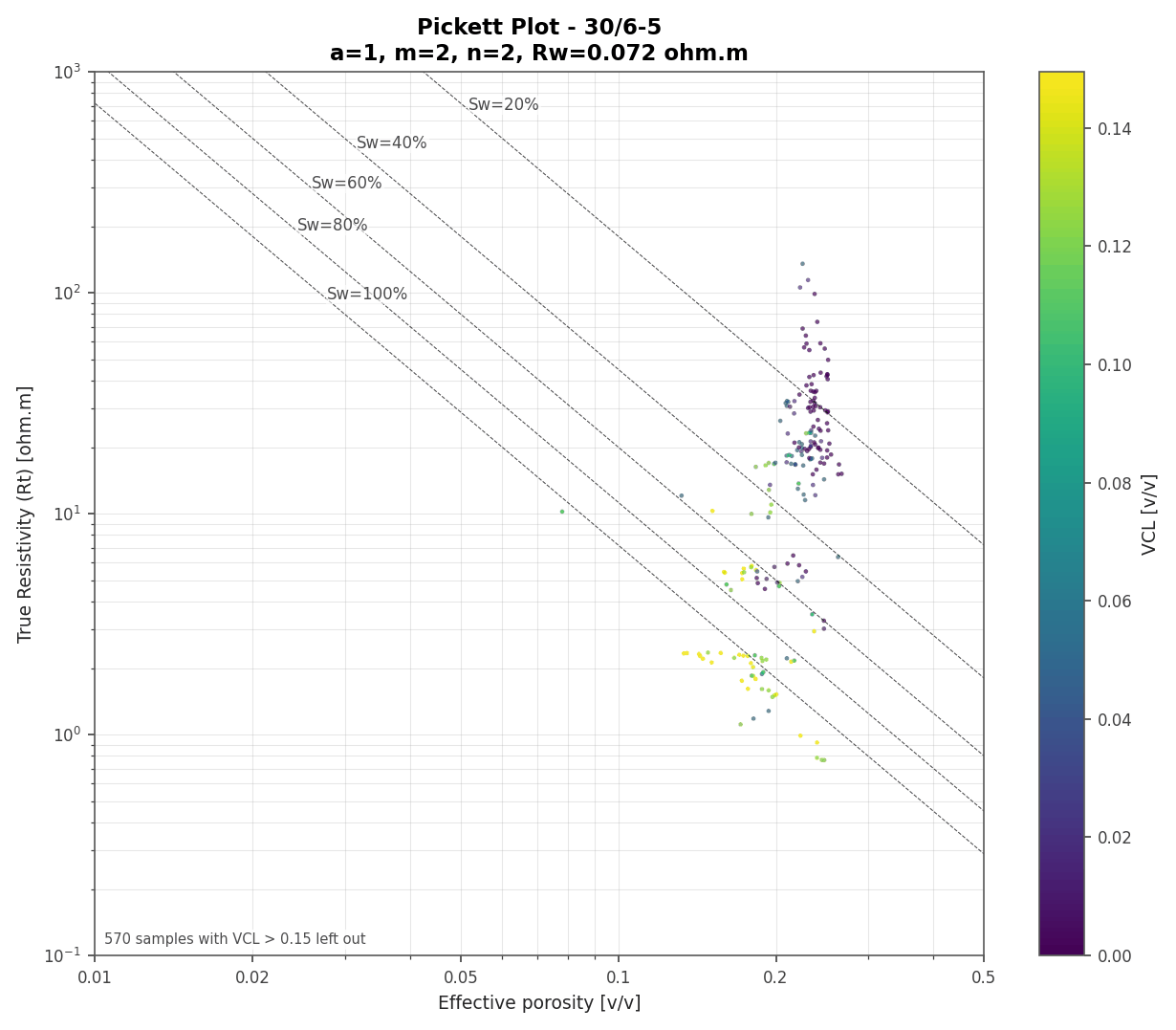
- The plot. Add it to Petrophys, on
petrophys(pp.<name>). Its docstring's first sentence becomes the candidate's title (figures.summary). - The line. A
DISPLAYSentry,"<function>": (<curve groups>). The kind must be lower-case letters with_(else the UI cannot serve the file). - Tests.
test_checks that everythe_ harness_ draws_ nothing_ itself_ and_ every_ plot_ is_ a_ petrophys_ function DISPLAYSfunction resolves, has a summary and a kind of letters; add a case totests/that binds it on a well that has its curves.figures/ test_ figures. py - Gates. The candidates are listed in the figures call's prompt (
figures.pick), so the mini set's taped figures call can differ (tests/): re-record it live after checking. Benchmark runs draw no figures, so the golden tapes are unaffected.gate/ test_ mini. py
Displays and their binding
| Name | Type | Default | Meaning | Defined in |
|---|---|---|---|---|
DISPLAYS |
dict | 9 displays | Petrophys function name to the curve groups it reads beyond those its signature names: one curve of each group must hold values in the interval (("NPHI", "PHIN") means NPHI or PHIN). () when the signature names all. |
figures.DISPLAYS |
| Function lookup | rule | petrophys.<name>: the plots Petrophys puts on pp (pp.pickett_plot, pp.crossplot, pp.plot). |
figures._function |
|
kind_of |
rule | The kind is the function name without create_/plot_ and _plot/_crossplot: pickett_plot gives pickett, zone_flags_plot zone_flags. |
figures.kind_of |
|
| Binding | rule | *_curve parameters take their default curve or the role's curve; number parameters the median of the role's curve, else the record's parameter, else Petrophys's default; array parameters the role's curve; _LEFT parameters (well, result, depth_range, figsize, title, cmap, color_curve, kwargs) are not bound. A required parameter that cannot be bound drops the display. |
figures.bind, figures._LEFT |
|
| Offered when | rule | Every curve it reads holds values and is among the curves the answer rests on (behind). |
figures.displays |
|
| Limits | integers | 3, 10, 16 | MAX_FIGURES per answer, MAX_RESULT_PLOTS from the cited results, MAX_CANDIDATES shown to the model. |
figures constants |
| File name | pattern | figure_<n>_<kind>.; the web UI serves only figure_\d+_[a-z]+(_[a-z]+)*\. (and the interval's overview.png). |
figures.attach, ui. |
|
| Result plots | dicts | FUNCTIONS and DRAW for log_viewer, histogram, crossplot; forms(f, item) maps a result's tool (stats, profile, crossplot, compare) to its plots. |
figures.FUNCTIONS, figures.forms |
All nine displays bind on the Brent Group of 30/6-5 (figures.bind). GeoLink 16/7-1 has no neutron log and no core, so the four displays that read NPHI and the flow units, which Petrophys draws from the core plugs, return None there and are never offered:
| Display | Kind | Curves on 30/6-5 Brent | On 16/7-1 (whole log, no NPHI) |
|---|---|---|---|
nd_plot |
nd |
NPHI, RHOB | not offered |
mn_plot |
mn |
NPHI, RHOB, DTC | not offered |
mid_plot |
mid |
NPHI, RHOB, DTC | not offered |
pickett_plot |
pickett |
PHIE, RDEP | PHIE, RDEP |
hingle_plot |
hingle |
PHIE, RDEP | PHIE, RDEP |
buckles_plot |
buckles |
PHIE, SW | PHIE, SW |
flow_unit_plot |
flow_unit |
PHIC, KH_CORE (the core plugs) | not offered |
triple_combo |
triple_combo |
GR, RDEP, RHOB, NPHI | not offered |
zone_flags_plot |
zone_flags |
NET_ROCK, NET_RES, NET_PAY | NET_ROCK, NET_RES, NET_PAY |
Tests and notes for a figure kind
.venv/bin/python -m pytest -o addopts= -q tests/figures/test_figures.py
.venv/bin/python -m pytest -o addopts= -q tests/gate
test_fails ifthe_ harness_ draws_ nothing_ itself... figures.pycallssubplots(,.hist(,.scatter(,.plot(,savefig(,add_subplot(orFigure(: drawing code belongs in Petrophys.- Petrophys draws one figure at a time (a lock) and each figure is closed once saved.
9. Add an interpretation setting mapping
The settings panel, POST /api/preview, ask(..., interpretation=...) and a conversation's settings changes all
read src/, so a mapping there reaches all four.
# src/petroharness/well/settings.py
GROUPS = [
    ...
    ("pay", "Net reservoir and pay", "The cutoffs that flag net reservoir and net pay.",
     ["vcl_cutoff", "phie_cutoff", "sw_cutoff", "reuse_input_resflag"]),
    ...
]
LABELS = {..., "vcl_cutoff": "VCL cutoff", ...}
- A new Petrophys setting (automatic). It appears under
More from Petrophyswith Petrophys's help, kind, choices and default. To place it, add its name to aGROUPSlist; give it a label inLABELS; add it toCOMMONto show it first. - A setting to keep out. Add its name to
HIDDEN. - A harness setting (zone rule). An entry in
ZONE_FIELDS; its default in_zone_default(a dict keyed by every zone field: a new key needs its entry, orschema()raisesKeyError); a field of the same name inconfig.DataPaths(strict: an unknown key is an error); and the zone code that reads it. - Tests.
tests/: every Petrophys setting offered once or hidden, labels and help, Petrophys's own choices, the policy's defaults, validation,test_ interpretation_ settings. py split, and that a run's settings reachpetrophys.and the zone rule.interpret - Gates. A setting left at its default changes nothing a question sends; the gates pass. Changing a default (the
policy's, or a harness default) changes the interpretation and so the prompts (
well.).settings. schema
The settings schema
| Name | Type | Default | Meaning | Defined in |
|---|---|---|---|---|
GROUPS |
list | 11 groups | (key, title, about, [Petrophys setting names]); the zones group holds the harness's zone rule. A Petrophys setting no group names and not hidden appears under More from Petrophys. |
well. |
HIDDEN |
set | 12 names | Settings left out: those that take a table, a list of wells or a file, and the library's internal flags. | well. |
COMMON |
set | Settings shown first in their group. | well. |
|
LABELS |
dict | key with spaces | The label shown. | well. |
UNITS |
tuple | (token in Petrophys's help, unit shown). | well. |
|
ZONE_FIELDS |
list | zone_, zone_vcl_bands, zone_layout |
The harness's own settings, with key, label, kind, unit, help, more, and choices/choice_labels where needed. |
well. |
| Defaults | rule | Zone settings: the policy's zones (_zone_default); vcl_cutoff, sw_cutoff, phie_cutoff: the policy's cutoffs (vcl_max, sw_max, phie_min_clastic); the rest: Petrophys's dataclass default. |
well. |
|
split |
function | Petrophys settings go to data.interpret (the options of petrophys.); zone settings to data.zone_*. |
well., interval. |
|
used |
function | The value Petrophys used for each setting, read from the step record (the applied <name>_used where recorded; the cutoffs from net_pay), with the unit the step records beside it. |
well.settings.used |
|
validate |
function | Per-setting errors: unknown name, wrong kind, a choice not listed, bands not two edges 0 < a < b < 1, a thickness not above 0, and whatever Petrophys's own validation refuses. |
well. |
Tests and notes for a setting
.venv/bin/python -m pytest -o addopts= -q tests/test_interpretation_settings.py
.venv/bin/python -c "from petroharness.well import settings; print([g['key'] for g in settings.schema()['groups']])"
curl -s localhost:7860/api/settings | python -c 'import json,sys; print([g["key"] for g in json.load(sys.stdin)["groups"]])'
With the pinned Petrophys every offered setting has a group, so the groups are the eleven of GROUPS:
['zones', 'clay', 'porosity', 'water', 'saturation', 'permeability', 'pay', 'temperature', 'mud', 'lithology', 'input']
- Petrophys settings cannot be combined with a context profile or a data interpreter; the zone rule can.
- The web UI renders whatever
GET /api/settingsreturns (Web UI API).
10. Add a dataset config
A dataset config is a settings file whose data: section says where a field's or a benchmark's wells and tops are,
and whose eval: section names its question file. A question about one LAS file needs none; benchmark mode and the
data tests do.
# configs/data.local.yaml (git ignores it), or any file PETROHARNESS_DATA names
data:
  las_dir: /data/myfield/las            # one LAS file per well, named <well>.las
  tops_csv: /data/myfield/tops.csv
  tops_columns: {well: uwi, name: form, top: top}
  tops_depth_unit: ft
  lithology_curve: null                 # each LAS's own lithology log, else Petrophys's solved lithology, else shale-volume bands
eval:
  questions: /data/myfield/questions.json
- The file. Copy
configs/todata. example. yaml configs/, or write any file and pointdata. local. yaml PETROHARNESS_DATAat it. Every key isconfig.DataPathsorconfig.EvalPaths(Configuration); a misspelt key is an error. - The tops.
tops_columnsmaps the table's columns when their names are notwell,nameandtop;top_name_patternkeeps the tops a regex on the upper-cased name matches;tops_depth_unitgives the table's unit when it is not the LAS's. - The reporting conventions. A dataset's own basis and conventions go in
data.basisanddata.conventions, never in code, a guide or a prompt (rules G6 and G8; Architecture). - No names in code. Well, formation and dataset names stay in the config:
tests/test_lint.pyfails on any of them in code, rules or prompts. - Check it.
petroharness setup --las <one well> --formation <name>prints the data settings a question builds from the file;PETROHARNESS_runs the data tests on its wells.DATA=<file> . venv/ bin/ python -m pytest -m data
11. Add a component text
Every text the model reads is an entry of one component (src/): a .md file holding
the exact bytes, or a .json file of such strings. Code holds no model-facing text.
# src/petroharness/agent/components/C10_reading/component.yaml
texts:
  empty_note: empty_note.md        # curves the question names that hold no values in this interval
from petroharness.agent import components as C
note = C.fill("C10", "empty_note", items=", ".join(names))
- The component. Pick the one that owns what the text does (Prompt components): a stage's instructions C5, a check's message C2, a writer rule C9, how evidence is read C10.
- The file. Write the text to a new file in the folder, with
{name}slots for what the code fills in, and list it undertextsincomponent.yaml. A.mdentry is read byte for byte, its trailing newline included. - The call.
C.text(cid, entry)gives the text as written,C.fills its slots, andfill(cid, entry, **values) C.also fills the shared slots (prompt(cid, entry, **values) {basis},{premise}). - The page. Add the entry's row to its component's table in PROMPT_COMPONENTS.md (Entry, File, Slots, Holds,
Used by):
test_fails until it is there.the_ components_ page_ lists_ every_ entry_ with_ its_ file - Gates. The new file changes the component's version stamp and, once a prompt holds it, what the model is sent:
on a path the benchmark takes, put it behind a switch and measure it (section 12)
before it stays.
test_checks it copies no other entry.no_ text_ is_ in_ two_ components
12. Make a behaviour change a switch
A switch exists only while a comparison needs it: it defaults off, and once measured it becomes the code or goes
(src/). Two switches are defined now. Each changes answers and waits on a fix before it
can become the code:
| Switch | On | Off (today) |
|---|---|---|
tight_numbers |
a mean is worked out only from three values or more, a small whole number with a unit is checked, and a number tied to a curve or zone is read only from a line naming one of them | a midpoint of two passes whatever the mean; 'net pay 12 m' is never checked; 'Z3 SW 0.45' passes on any 0.45 |
cell_thickness |
n regularly spaced samples are n steps thick (Petrophys's cells): a zone, a count of samples, the interval | first to last sample: one sample step less than Petrophys's gross for the same interval |
# src/petroharness/options.py
@dataclass(frozen=True)
class Options:
    my_change: bool = _switch("what it does on", "what happens off, today")   # the switch under test

# where the behaviour lives
from petroharness import options
if options.get().my_change:
    ...                              # the new behaviour
else:
    ...                              # the current behaviour, unchanged

# a test
with options.use(my_change=True):
    ...
- The field. Add the switch to
Optionsinoptions.pywith_switch, off by default, saying what it does on and what happens off; the table above is generated from these fields. - The branch. Read
options.where the behaviour lives, keeping the current path byte for byte when off; or tag guide lines and guides. Model-facing text goes into a component entry, not into code.get().<name> - Tests.
tests/asserts that every switch is off by default. Add a test of the behaviour both ways: as today, and underagent/ test_ options. py::test_ every_ switch_ is_ off_ by_ default_ and_ an_ empty_ setting_ parses options..use(<name>=True) - Gates with the switch off. The mini set, the golden tapes, the prompt fixture and the request gate must pass unchanged (only version stamps may differ; Testing).
- Measure. Run the questions with
PETROHARNESS_against a control run at the same time, two runs of each; read the answers before any automatic scoring; record what was measured (AGENTS.md rule 8).SET=<name>=true - Adopt or drop. Adopt: make the new path the code, delete the field, the branch and any guide tags, update
test_options.py, re-record the gates live. Drop: delete the field and its branch.
PETROHARNESS_SET=my_change=true petroharness benchmark --arm test --rep 1 --cats porosity
PETROHARNESS_SET= petroharness benchmark --arm control --rep 1 --cats porosity
The switch mechanism
| Name | Type | Default | Meaning | Defined in |
|---|---|---|---|---|
Options |
frozen dataclass | the switches above | One field per switch: bool, off by default (_switch(on, off)), or str = "" for a list of names joined by +. |
options.Options |
PETROHARNESS_SET |
environment | unset | name=true,other=a+b for one run. Booleans take true, false, 1, 0, on, off; strings [a-z_]+ joined by +. An unknown name raises PETROHARNESS_. |
options.ENV, options.parse |
options.get() |
function | The options in force (an override from use, else the environment). |
options.get |
|
options.use(**kw) |
context manager | Tests: switches set inside the block; an unknown name raises TypeError. |
options.use |
|
options.as_dict() |
function | The options as a dict; recorded in every trace as trace["options"]. |
options.as_dict, agent.graph.close |
|
| Guide line tags | text | [name] text shows a guide line only while the switch is on; [!name] text only while it is off. |
direction.gated |
|
| Guide gate | frontmatter | option: name: the guide is listed in the index only while the switch is on. |
direction. |
|
| Unknown switch in a guide | error | switch_on raises KeyError: no switch '<name>' (switches: ...); a library whose tag names no switch does not load. |
direction. |
|
| Golden comparison | rule | A switch the recording does not know must be off; a switch removed from the code passes only when recorded at the value fixed in code (fixed). |
tape.compare_run |
PETROHARNESS_compares two copies of the component texts the same way without a code switch.COMPONENTS=<folder> - While a guide carries a switch tag,
tests/fails by design.agent/ test_ skills. py::test_ skills_ are_ generic
13. Keep the gates green
What each kind of change does to the four gates (Testing), and how to re-record:
| Change | Effect | What to do | Defined in |
|---|---|---|---|
| Pure refactor, comment, docstring | No request change | All gates pass. Component version stamps change when the file is a frame: the golden test warns; re-record by replay to clear it. | tape.compare_run, components.version |
| What is done with replies (parsing, the ledger's bookkeeping, the checker, the answer file), no request change | Results change | The golden results and the mini set's expectations differ while every request is equal: re-record by replay (record_, record_). |
record_golden.one, record_mini.replay |
| A model-facing text, a tool, a Petrophys build, a guide of the packaged library, the default card | Requests change | TapeMismatch in the mini set and the golden tapes; the prompt fixture differs; the request gate counts differences. A behaviour change: switch, measure, then re-record live and re-render the fixture. |
AGENTS.md rule 7 |
| Conversation-only parts (figures, later questions, the session log) | Conversation | The mini set reaches them; the golden tapes (first questions, no figures) do not. | tests/ |
| A new card, a new library not plugged by default, a setting left at its default | None | No gate changes. |
- Never re-record to make a failing gate pass without knowing why it failed: if the change was not meant to alter what
the model is sent, the difference the gate names is the bug (
tests/).gate/ README. md - Re-record the tapes, the mini set and the fixture in the same change as the behaviour they record.
Replay or live
Choose how to re-record by what the change does to the requests.
| Name | When | Meaning | Defined in |
|---|---|---|---|
| Replay | every request is unchanged | No model server. The recorder stops, and writes nothing (mini set) or exits at the question (golden), at the first request the tape does not hold: that is the sign a live recording is needed. | record_mini.replay, record_golden.one |
| Live | after a measured, adopted behaviour change | Needs the default model at PETROHARNESS_ (and WELLLOGBENCH for the golden tapes). Record from a clean checkout of the commit the tapes are for; the commit is written into selection.json. |
record_mini.record, record_golden.main |
| Prompt fixture | after an intended prompt change | Re-render: check every changed line is intended, then render with prompt_fixture.py and keep the label the test expects. |
tests/ |
| Request gate base | after adoption | The adopted change's measured runs become the reference runs, and the gate's base is recorded again from them (Development). | tests/ |
A live recording of the mini set (record_mini.record) writes into a new folder and replaces the set's folder only
when every question was answered; a failed question leaves the earlier recording as it was.
Commands: re-record and check the gates
# 1. replay-only change: keep the tapes, rewrite what the code gives from them
WELLLOGBENCH=/path/to/configs PYTHONPATH=src:tests/agent .venv/bin/python tests/agent/record_golden.py replay
.venv/bin/python tests/gate/record_mini.py --replay
# 2. measured request change, adopted: record from the model again
WELLLOGBENCH=/path/to/configs PETROHARNESS_MODEL_URL=http://localhost:8000/v1 PYTHONPATH=src:tests/agent \
    .venv/bin/python tests/agent/record_golden.py live --workers 12 <dataset> ...
PETROHARNESS_MODEL_URL=http://localhost:8000/v1 .venv/bin/python tests/gate/record_mini.py
PYTHONPATH=src PETROHARNESS_DATA=/path/to/configs/<dataset>.yaml \
    .venv/bin/python tests/agent/prompt_fixture.py IDS_DIR tests/agent/fixtures/prompts.json.gz LABEL
record_mini.py takes set names (brent, the one set: GeoLink 30/6-5, Brent Group); with none it records or
replays every set. Then check:
.venv/bin/python -m pytest -o addopts= -q tests/gate
WELLLOGBENCH=/path/to/configs .venv/bin/python -m pytest -o addopts= -q -m data -n 12 tests/agent/test_golden_tapes.py
PETROHARNESS_DATA=/path/to/configs/<dataset>.yaml .venv/bin/python -m pytest -o addopts= -q -m data \
    tests/agent/test_skill_library.py
14. Limits and errors
A definition error stops the import, a broken library stops the run before its first question, and most other mistakes fail a named test.
Every error and failing test, by situation
| Situation | What happens | Where |
|---|---|---|
A tool defined twice, in an unknown group, or with a required/lead it does not define |
ValueError with WHAT / FIX when the harness is imported |
tools. |
| A tool's schema shows an argument its function does not take | test_ fails |
tests/ |
A catalog computation or a toolset tool reaches no Petrophys function and is not in GENERIC or RECORD_READERS |
test_ fails with the fix |
tests/ |
A Petrophys module no PACKAGES prefix matches |
Its functions are not in the registry | library.api._verb |
| A Petrophys module that fails to import | Silently offers nothing | library. |
A guide with an unknown frontmatter key, an area not in topics.yaml, a line without provenance, or a tag naming no switch |
The library does not load; the run stops before its first question | direction., direction.load |
| A guide over 9000 characters or an index over 4000 | tests/ fails |
INDEX_MAX, GUIDE_MAX |
| A report style the policy names is missing | FileNotFoundError WHAT: report style <path> not found. ... |
profile.profile |
A report style with a top-level key other than format |
test_ fails |
tests/ |
| A misspelt model card field | ValueError naming the field; the command or UI exits 2 |
models. |
| An unknown packaged card name | WHAT: no model card '<name>'. FIX: ... the name of a packaged card: <names>. |
models.card_file |
| A display function Petrophys does not export | LookupError: petrophys. in the test; such a display is never offered |
figures._function |
A display kind with characters other than lower-case letters and _ |
The UI cannot serve the figure (404) | ui. |
A new zone-rule field without its _zone_default entry |
schema() raises KeyError |
well. |
A zone-rule field without a DataPaths field |
The data settings are refused as an unknown key | config.DataPaths |
PETROHARNESS_SET naming no switch |
ValueError: PETROHARNESS_ |
options.parse |
| A recording with a switch the replay turns on | The golden comparison fails: trace. |
tape.compare_run |
15. Related pages
- Rules for changes: the rules for changing the code, each with its reason.
- Design rules: the design rules and the generality contract G1 to G8.
- Contributing: where a contribution goes and how to show it is safe.
- Testing: the suite, the gates, their recorders and the component version stamps.
- Tools: the tools by request and the verbs over Petrophys.
- Skills README: the skill library format in full.
- Components README: the component texts, versions and attribution.
- Models: model cards and their fields.
- Conversations: figures, settings changes and field notes in a conversation.
- Web UI API: the settings and figure routes of the web UI.
- Development: configuration, benchmark mode and the reference runs.