1. At a glance
flowchart LR
    input["LAS file<br/>interval, question"] --> ask["ask()"]
    ask --> result["AskResult<br/>answer.md, trace.json"]
    input --> start["Conversation.start()"]
    start --> conv["c.ask() per question<br/>c.adopt() for settings"]
    conv --> turn["Turn<br/>answer, figures, basis"]
    conv --> folder[("session folder<br/>log.jsonl, blobs/, turns/NN/")]
    folder --> resume["Conversation.resume()"]
    resume --> conv
    folder --> eg["EvidenceGraph.from_log()"]
    eg --> docs["audit.markdown()<br/>report.markdown()"]
One question about the Brent Group:
import petrophys
from petroharness.ask import ask

r = ask(petrophys.sample("30/6-5"),
        "What are the porosity, water saturation and permeability of the Brent Group, and is any of it hydrocarbon-bearing?",
        tops=petrophys.sample("formations_30_6-5.csv"), formation="BRENT GP.",
        model_url="http://localhost:8000/v1", out="out/brent")
print(r.status)                        # ok, unresolved_numbers, or error: ...
print(r.interval)
# {'name': 'BRENT GP.', 'top': 2841.0, 'base': 2958.0, 'unit': 'm', 'samples': 768,
#  'from': 'tops file formations_30_6-5.csv, base: stated base'}
print(r.trace["ask"]["lithology"])
# {'source': 'lithology log', 'curve': 'LITHOLOGY_GEOLINK', 'how': 'detected'}
- Wrong inputs raise before any model call. A run that fails does not raise: its
statusiserror: <type>(section 12). - The model is reached at
model_url, elsePETROHARNESS_;MODEL_ URL llm_factoryplugs in a client of your own (section 11). out=Nonewrites nothing. A conversation always keeps its session folder.
| Object | Module | Purpose | Returns or holds |
|---|---|---|---|
ask() |
petroharness.ask |
One question about one LAS file | AskResult |
prepare(), task_for(), check(), ask_record() |
petroharness.ask |
The steps of ask() before and after the model runs |
Prepared, Task, the trace's ask block |
Conversation |
petroharness. |
Any number of questions on one interval, kept in a session folder | Turn per question |
SessionLog |
petroharness. |
The append-only event log of a conversation | events, blobs |
answer(), benchmark(), main() |
petroharness.cli |
A prepared task through the question graph; the console script | {"answer", "status", "trace"} |
EvidenceGraph, audit, report |
petroharness. |
The evidence graph of a session folder, its audit trails, the conversation document | graph, Markdown, JSON |
Setup, of(), config_for(), differences() |
petroharness. |
The setup record and its hash | Setup, a 12-character hash |
schema(), validate(), load() |
petroharness., petroharness. |
Interpretation settings and field notes files | dicts |
tape.record(), tape.Replayer |
petroharness.tape |
Record and replay model calls | tapes |
Configuration objects (HarnessConfig, given_settings, the model registry) are in
Configuration.
2. How it works
ask() prepares the interval, has Petrophys interpret the well, runs the question graph and records what was asked
(src/):
flowchart LR
    q["ask(las, question, ...)"] --> key["_model_key<br/>registry key"]
    key --> prep["prepare()<br/>data settings, interval,<br/>skills -> Prepared"]
    prep --> task["task_for()<br/>Task + question sent"]
    task --> chk["check()<br/>skill library loads;<br/>Petrophys interprets;<br/>on_view(view)"]
    chk --> qg["agent.graph.answer<br/>under given_settings"]
    qg --> rec["ask_record()<br/>trace['ask']"]
    rec --> res["AskResult<br/>(+ answer.md, trace.json)"]
Conversation.ask() runs one question through the session graph instead, open -> turn -> project -> figures -> commit (petroharness., The three graphs): the first question is answered
as ask() answers it, a later one on the same ledger with the earlier questions in view.
The steps of ask(), one by one
- Resolves
lasto an absolute path and strips the question; a missing file or an empty question raises. - Picks the model registry key with
_model_key: the endpoints frommodel_url, elsePETROHARNESS_, and the card fromMODEL_ URL model_cardandmodel(petroharness.).models. register - Loads
field_noteswithpetroharness.and puts their settings underwell. notes. load interpretation. - Calls
prepare(): the data settings for this LAS (_settings), the interpretation settings (_interpretation), the interval (_interval), the depth unit and the skill library, as aPrepared. The interpreted well is cached in<out>/.cache, or in a temporary folder removed whenask()returns. - Calls
task_for()for theTaskand the question as sent, thencheck(): the skill library must load, Petrophys interprets the well, the interval must hold samples, andon_view(view)is called. - Inside
config., runs the question graphgiven_ settings(p. given) agent.graph.answer(rep 1, writeropen, formatprofile, step capmax_stepsor 8) (The three graphs). - Adds
answerand theaskblock (ask_record()) to the trace (whichagent.graph.answerhas stamped with the setup it answered under,setupandsetup_parts), builds theAskResultand, without, writesanswer.mdandtrace.json.
3. One question: ask
ask
ask() answers one question about one interval of one LAS file and returns an AskResult. The interval is a
formation of a tops file, a pair of depths, or, with neither, the whole well.
ask(las, question: str, *, formation=None, tops=None, top=None, base=None, depth_unit=None, lithology_curve=None,
    formation_lithology=None, profile=None, out=None, model_url=None, model=None, model_card=None, settings=None,
    skills=None, max_steps=None, llm_factory=None, on_view=None, direct=True, interpretation=None,
    field_notes=None, zones=None, zones_sheet=None) -> AskResult
# the cored interval of 25/5-1, by depth (no tops file ships with it)
r = ask(petrophys.sample("25/5-1"), "How does the log porosity compare with the core porosity?",
        top=2990, base=3290, model_url="http://localhost:8000/v1")
r.interval
# {'name': 'depth interval 2990-3290 m', 'top': 2990.0, 'base': 3290.0, 'unit': 'm', 'samples': 1969,
#  'from': 'depths given'}

# the Brent Group under interpretation settings of your own (endpoint from PETROHARNESS_MODEL_URL)
r2 = ask(petrophys.sample("30/6-5"), "Which zone has the best reservoir quality?",
         tops=petrophys.sample("formations_30_6-5.csv"), formation="BRENT GP.",
         interpretation={"rw": 0.05, "sw_model": "indonesia", "m": 2.2, "zone_min_thickness_m": 1.0})
Arguments of ask()
| Argument | Type | Default | Meaning | Defined in |
|---|---|---|---|---|
las |
path or str | required | The well's LAS file. | ask.ask |
question |
str | required | The question; stripped, must not be empty. | ask.ask |
formation |
str or None | None | The formation in tops, or a label for top/base; alone, looked up in the settings' data.tops_csv. |
interval._interval |
tops |
path or None | None | A tops table (CSV, TSV or Excel), columns found by meaning (Evaluate a formation). Excludes base; with top, the row of that top for a name the table lists twice. |
well., TopsTable.interval |
top, base |
float or None | None | The interval's depths, both included; one alone runs to the log's first or last depth. With tops, top is the top of the row meant, as the file writes it. |
interval._interval |
depth_unit |
"m", "ft" or None |
None (the tops file's unit, else the LAS's) | The unit of the depths given and of the answer's depths. | interval._interval |
lithology_curve |
str or None | None (detected) | The lithology log's mnemonic. | interval._settings, ask.check |
formation_ |
str or None | None | The formation's lithology as the user states it; added to the question. | interval.task_for |
profile |
str or None | None | A Petrophys context profile (interpret: {context_). |
interval._settings |
out |
path or None | None | A folder for answer.md, trace.json and .cache/. None writes nothing. |
ask.ask |
model_url |
str or None | None (PETROHARNESS_) |
The endpoints, comma-separated. | ask._model_key |
model |
str or None | None | The served model's name (the generic card unless model_card is given). |
models.card_file |
model_card |
str or None | None (the K2-Horizon-7B card) | A model card's YAML file, or a packaged card's name. | models.card_file |
settings |
path or None | None (PETROHARNESS_DATA if set) |
A data settings YAML whose data: section is the base. |
interval._settings |
skills |
str or None | None (PETROHARNESS_, else the packaged library) |
A skill library folder, or "none". |
interval.prepare |
max_steps |
int or None | None (8, agent.) |
The investigation's step cap. | ask.ask |
llm_factory |
callable or None | None (petroharness.) |
llm_factory(cfg) returns the model client (section 11). With it and no endpoint, no endpoint is needed. |
ask._model_key |
on_view |
callable or None | None | Called with the interval's FormationView once Petrophys has interpreted the well, before the first model call. |
ask.check |
direct |
bool | True | The model first says whether the question is direct; False gives every question the full investigation. | agent.graph.turn |
interpretation |
dict or None | None | Interpretation settings, {setting: value} (Configuration); over the field notes' settings. |
interval. |
field_notes |
path or None | None | A field notes file: its settings are in force, its notes go with the question. | well.notes.load |
zones |
path or None | None | Your zones: a table (CSV, TSV or Excel) of zone, top and bottom (optional depth_unit and well columns). They frame the answer in place of the lithology zones (Z1, Z2, ... under your names; the lithology zones are kept as L1, L2, ...). |
well. |
zones_sheet |
str or None | None (the first sheet) | The Excel sheet of the zones. | well. |
Errors and failed runs of ask()
- Wrong inputs raise before any model call:
FileNotFoundError,ValueError, orFormationNotFound(aLookupError) for a name the tops file lacks. A Petrophys failure raisesRuntimeError. - A failure during the question graph does not raise: the result's
statusiserror: <exception type>, and the trace holdserrorandtraceback. A writer whose last draft is empty givesstatuserror: empty answer (the writer's last draft was empty), with that reason in the trace'serror. - A bad skill library raises
LibraryError(aValueError) incheck(), before Petrophys interprets the well. interpretationwith Petrophys settings and aprofile(or a datainterpreter) raisesValueError; the zone rule (zone_,min_ thickness_ m zone_vcl_bands,zone_layout) may be set with either.
Three interval errors on the sample wells that have them, as prepare() raises them for ask() (each says what is
wrong, why, and the fix; prepare, Inputs and key as in section 4):
s = petrophys.sample
# a tops file that lists a formation twice (Taranaki tuhua-7)
prepare(Path(s("tuhua-7")).resolve(), key, Inputs(tops=s("formations_tuhua-7.csv"), formation="Manganui"),
        cache=Path("cache"))
# FormationNotFound: WHAT: formation 'Manganui' is listed 2 times in formations_tuhua-7.csv (line 3: top 874.014,
# base 1250.75; line 10: top 2164.99, base 2347.42). WHY: a repeated name (e.g. a repeated section) does not say
# which interval is meant. FIX: choose the one you mean by its top: --formation NAME --tops FILE --top D, or give its
# depths alone: --formation NAME --top D --base D.

# a tops file in feet asked for in metres (KGS 1046123714)
prepare(Path(s("1046123714")).resolve(), key, Inputs(tops=s("1046123714_formation_tops.csv"),
        formation="Lansing-Kansas City", depth_unit="m"), cache=Path("cache"))
# ValueError: WHAT: the tops file 1046123714_formation_tops.csv states its depths in ft and the depth unit given is
# m. WHY: one of them is wrong. FIX: drop --depth-unit (the file's unit is used) or correct the file.

# a multi-well tops table that has no rows for this well (the COSTA table, read for GeoLink 30/6-5)
prepare(Path(s("30/6-5")).resolve(), key, Inputs(tops=s("formations_costa.csv"), formation="KHARAIB-2"),
        cache=Path("cache"))
# FormationNotFound: WHAT: the tops file formations_costa.csv has no rows for this well (it goes by '30_6-5',
# '30/6-5', '30/6-5'; the file's well column lists HW-3, HW-4, HW-5, HW-6, HW-7, HW-8, HW-9, HW-10, HW-24, HW-25,
# HW-26, HW-27, HW-28, HW-29, HW-30, HW-31, HW-32). WHY: a table with a well column is read for this well only. FIX:
# put this well's name (the LAS file's name or its WELL header) in that column, or drop the column from a table that
# holds only this well.
Data: Taranaki Basin Curated Well Logs Dataset (New Zealand Petroleum & Minerals), CDLA-Sharing-1.0. Kansas Geological Survey (kgs.ku.edu). Costa Gomes, Geiger and Arnold (2022), COSTA model, Heriot-Watt University, CC BY.
AskResult
AskResult is the dataclass ask() returns: the answer as delivered, its status, the full trace, the interval
asked about, and the files written. ok is True unless status starts with error.
Fields of AskResult
| Field | Type | Default | Meaning | Defined in |
|---|---|---|---|---|
answer |
str | required | The answer as delivered ("" when there is none). | ask.AskResult |
status |
str | required | ok, unresolved_numbers (a number no result shows survived the checker), error: <type>, or error: empty answer (the writer's last draft was empty). |
ask.AskResult, agent. |
trace |
dict | required | The full trace (Architecture), plus answer, the ask block, and the setup: setup (its hash) and setup_parts (the record, Audit an answer). |
ask.ask, agent.graph.answer |
interval |
dict | required | What was asked about: name, top and base (rounded to 4 decimals), unit, samples, from. |
ask.check |
out_dir |
Path or None | None | The output folder, when out was given. |
ask.AskResult |
files |
dict | {} |
{"answer": Path, "trace": Path} when files were written. |
ask.ask |
ok |
property, bool | - | True unless status starts with error. |
ask.AskResult.ok |
The trace's ask block, on 30/6-5 Brent
{"ask": {"las": ".../petrophys/datasets/geolink/30_6-5.las",
         "question": "What are the porosity, water saturation and permeability of the Brent Group, and is any of it hydrocarbon-bearing?",
         "question_sent": null,
         "interval": {"name": "BRENT GP.", "top": 2841.0, "base": 2958.0, "unit": "m", "samples": 768,
                      "from": "tops file formations_30_6-5.csv, base: stated base"},
         "lithology": {"source": "lithology log", "curve": "LITHOLOGY_GEOLINK", "how": "detected"},
         "zones": [{"zone": "Z1", "lithology": "SAND", "top": 2841.3242, "base": 2845.7439}, "... (20 zones)"],
         "model": "K2-Horizon-7B", "settings": "built from the LAS",
         "skills": {"library": "researched", "version": "18c03ad5d3f8"}, "skills_given": null,
         "interpret": {"vcl_cutoff": 0.3, "sw_cutoff": 0.7}, "interpreter": null,
         "petrophys": "3.0.0@files-c5de047fe601"}}
question_sentis the question as the model read it, when it differs (the operator's lithology or the field notes added);field_notes(name,sha256,settings,notes) is present only when a file was given.lithology.sourceislithology log(withcurveandhow:namedordetected),mineral solver(no lithology log: the lithology Petrophys's mineral solver wrote, with itscurve,method,domain,inputs,decisions, and the well'ssolvedandsamples),shale-volume bands(withbands; neither a log nor a solved lithology) ornone. A well without a lithology log, such as Taranaki tuhua-7 (McKee Formation), gives{"source": "mineral solver", "curve": "LITHO", "method": "canonical_.multi_ mineral_ solver", "domain": "clastic", "inputs": ["RHOB", "VCL", "NPHI", "PHIE", "PEF", "DTC"], "decisions": ["No lithology curve or lithology intervals were available -> inferred LITHO from mineral volumes", "..."], "solved": 13418, "samples": 13652}
4. The building blocks of ask
ask() is prepare(), task_for() and check(), then the question graph, then ask_record(). The first three call
no model: they check an interval, and have Petrophys interpret it, before any question is asked.
from pathlib import Path
import petrophys
from petroharness.ask import Inputs, check, prepare, task_for
from petroharness.models import register

las = Path(petrophys.sample("30/6-5")).resolve()
key = register(["http://localhost:8000/v1"])            # the default card on this endpoint: 'k2-horizon-7b'
p = prepare(las, key, Inputs(formation="BRENT GP.", tops=petrophys.sample("formations_30_6-5.csv")), cache=Path("cache"))
print(p.source, p.data["interpret"])                    # built from the LAS {'vcl_cutoff': 0.3, 'sw_cutoff': 0.7}
task, sent = task_for(p, "Which zone has the best reservoir quality?")
check(p, task)                                          # Petrophys interprets the well
print(p.used["samples"], len(p.view.zones), p.litho["curve"])      # 768 20 LITHOLOGY_GEOLINK
A whole-log question on an old well logged in feet, with no lithology log (Teapot 17-WX-21): with no formation and no depths the interval is the whole log, in the LAS's own unit, and the zones are runs of the lithology Petrophys's mineral solver wrote.
from petroharness.well import settings

p = prepare(Path(petrophys.sample("teapot_17-wx-21")).resolve(), key, Inputs(), cache=Path("cache"))
task, sent = task_for(p, "Where are the porous intervals in this well, and what do they hold?")
check(p, task)
p.used
# {'name': 'whole well', 'top': 0.0, 'base': 5649.5, 'unit': 'ft', 'samples': 11300,
#  'from': 'the whole log (no formation or depths given)'}
p.litho["source"], p.litho["curve"], p.litho["domain"], len(p.view.zones)
# ('mineral solver', 'LITHO', 'clastic', 102)
used = settings.used(p.view.prep)                       # what Petrophys used, read from its step record
used["sw_model"], used["a"]
# ({'value': 'indonesia+archie', 'step': 'saturation'}, {'value': 0.81, 'step': 'saturation'})
Data: Teapot Dome (NPR-3), RMOTC, U.S. Department of Energy.
Intervals, units and missing logs on other sample wells
Each case on the sample well that has it, through the same three calls:
def interval(name, **kw):                     # the interval as ask() would use it, with no model call
    p = prepare(Path(petrophys.sample(name)).resolve(), key, Inputs(**kw), cache=Path("cache"))
    check(p, task_for(p, "(the interval)")[0])
    return p

# a tops file in feet; with no stated base, the base is the next top (KGS 1046123714)
interval("1046123714", tops=petrophys.sample("1046123714_formation_tops.csv"), formation="Lansing-Kansas City").used
# {'name': 'Lansing-Kansas City', 'top': 3991.0, 'base': 4080.0, 'unit': 'ft', 'samples': 178,
#  'from': 'tops file 1046123714_formation_tops.csv, base: next top LKC G'}

# the same interval asked for in metres on that feet log: the answer reports in metres
interval("1046123714", top=1216.5, base=1243.6, depth_unit="m").used
# {'name': 'depth interval 1216.5-1243.6 m', 'top': 1216.5, 'base': 1243.6, 'unit': 'm', 'samples': 178,
#  'from': 'depths given'}

# a multi-well tops table with a well column: the rows of this well are read (COSTA HW-3, a carbonate in feet)
interval("HW-3", tops=petrophys.sample("formations_costa.csv"), formation="KHARAIB-2").used
# {'name': 'KHARAIB-2', 'top': 7805.0, 'base': 8020.0, 'unit': 'ft', 'samples': 431,
#  'from': 'tops file formations_costa.csv, base: stated base'}

# a well with no neutron and no PEF log (GeoLink 16/7-1): Petrophys interprets it and records what it did instead
p = interval("16/7-1")
"NPHI" in p.view.prep.input_curves, "PEF" in p.view.prep.input_curves          # (False, False)
p.view.prep.steps["porosity"]["parameters"]["phit_method"]                     # 'density_only'
p.view.prep.steps["porosity"]["decisions"]          # among them:
# 'Density-only porosity: PHIT = PHID because PHIN was unavailable'
Data: Kansas Geological Survey (kgs.ku.edu). Costa Gomes, Geiger and Arnold (2022), COSTA model, Heriot-Watt University, CC BY. GeoLink, CC BY-SA 4.0.
prepare
prepare() builds the data settings and the interval for one LAS, with no model call and no interpretation yet.
prepare(las: Path, key: str, inputs: Inputs, *, cache: Path) -> Prepared

Inputs(formation=None, tops=None, top=None, base=None, depth_unit=None, lithology_curve=None, formation_lithology=None,
       profile=None, settings=None, skills=None, interpretation=None, field_notes=None, zones=None, zones_sheet=None)
| Argument | Type | Default | Meaning | Defined in |
|---|---|---|---|---|
las |
Path | required | The LAS file, already resolved to an absolute path. | interval.prepare |
key |
str | required | A model registry key (petroharness.). |
interval.prepare |
inputs |
Inputs |
required | What the interval is prepared from: the arguments ask(), a conversation, the web UI and the setup command share, one field each. Inputs.of(mapping) takes the fields a mapping or an argparse namespace holds. |
interval.Inputs |
inputs.formation ... inputs.skills |
as ask() |
as ask() |
As in ask(). |
interval.prepare |
inputs. |
dict or None | None | The settings in force; a field notes file's settings are merged under them. | interval., Inputs.loaded |
inputs.field_notes |
path, dict or None | None | A field notes file, or the notes already read from one (well.). |
Inputs.loaded |
inputs.zones, inputs.zones_sheet |
as ask() |
as ask() |
Your zones, read into data.zones (and the file's name into data.zones_source). |
interval.prepare, well. |
cache |
Path | required | The folder the interpreted well is cached in (data.cache_dir unless the settings file sets one). |
interval._settings |
- The data settings start from
settings(elsePETROHARNESS_DATA);las_dirdefaults to the LAS's folder andcache_dirtocache. The full order: Configuration. data.depth_unitis set to"las"when the report unit is the LAS's own, else to the report unit, unless the settings file sets it. Adepth_unitargument wins over the settings file's.
Prepared
Prepared is the dataclass for one interval of one LAS, ready for questions.
| Field | Type | Default | Meaning | Defined in |
|---|---|---|---|---|
las |
Path | required | The LAS file. | interval.Prepared |
key |
str | required | The model registry key. | interval.Prepared |
data |
dict | required | The data settings built for this LAS (the data: section, Configuration). |
interval._settings |
source |
str | required | Where they came from: the settings file's path, or built from the LAS. |
interval._settings |
span |
dict | required | The interval asked about: name, top, base, closed, unit, from, las_unit, report, and units (the tops file's units inside the interval) when it lists any. |
interval._interval |
said |
str | required | The operator's lithology for the formation ("" when not given). | interval.prepare |
given |
dict | required | The settings every question runs under, for config.: {"data", "eval": {}, "skills"?}. |
interval.prepare |
skills_given |
str or None | None | The skills argument as given. |
interval.prepare |
lithology_curve |
str or None | None | The lithology curve named. | interval.prepare |
view |
FormationView or None | None | The interval's view, set by check(). |
ask.check |
used |
dict | {} |
The interval as used, set by check() (AskResult.interval). |
ask.check |
litho |
dict | {} |
Where the zones came from, set by check(). |
ask.check |
notes |
dict | {} |
The field notes in force. | interval.prepare |
p.span          # 30/6-5, Brent Group
# {'name': 'BRENT GP.', 'top': 2841.0, 'base': 2958.0, 'closed': True, 'unit': 'm',
#  'from': 'tops file formations_30_6-5.csv, base: stated base',
#  'units': [['Ness Fm.', 2841.0, 2865.0], ['Etive Fm.', 2865.0, 2958.0]], 'las_unit': 'm', 'report': 'm'}
prepare(Path(petrophys.sample("25/5-1")).resolve(), key, Inputs(top=2990, base=3290), cache=Path("cache")).span
# {'name': 'depth interval 2990-3290 m', 'top': 2990.0, 'base': 3290.0, 'closed': True, 'unit': 'm',
#  'from': 'depths given', 'las_unit': 'm', 'report': 'm'}
task_for, check and ask_record
These three functions turn a Prepared into a question the graph can run and record what was asked.
| Function | Returns | Arguments (defaults) | Meaning | Defined in |
|---|---|---|---|---|
task_ |
(Task, str) |
turn: the question's number in a conversation |
The Task (id a + 10 hex digits of a SHA-256 of the LAS, question, interval and turn) and the question as sent: with (The operator states this formation's lithology: ...), the tops file's units inside the interval under reach: focus ((The tops file lists these units inside this interval: ...); under the default reach: well the map lists the file's units instead) and the field notes statement appended when present. |
interval.task_for |
check(p, task, on_ |
None | on_view: callback |
Builds the FormationView (Petrophys interprets the well), raises when the interval has no samples or the named lithology curve has no data, fills p.view, p.used, p.litho, then calls on_view(view). |
ask.check |
ask_ |
dict | none | The trace's ask block (AskResult). |
ask.ask_record |
p = prepare(las, key, Inputs(formation="BRENT GP.", tops=petrophys.sample("formations_30_6-5.csv"),
                             formation_lithology="sandstone"), cache=Path("cache"))
task_for(p, "Which zone has the best reservoir quality?")[1]
# "Which zone has the best reservoir quality?\n\n(The operator states this formation's lithology: sandstone.)"
- The operator's lithology is appended unless the zone layout is
formation, which shows it on the zone. check()runs under the prepared data settings directly (HarnessConfig(data=DataPaths(**p.), so a misspelt data key raises here.data), eval=None)
parser, interval_options, run_options, options and main
These functions are the question command; chat and setup reuse the option groups.
| Function | Returns | Arguments (defaults) | Meaning | Defined in |
|---|---|---|---|---|
parser() |
argparse. |
none | The question command's parser (prog="petroharness"): --las (required), --question or --question-file, --out, and the two option groups. |
ask.parser |
interval_ |
None | ap: a parser |
Adds --formation, --tops, --zones, --zones-sheet, --top, --base, --depth-unit, --lithology-curve, --formation-lithology, --field-notes, --profile. |
ask. |
run_ |
None | ap: a parser; endpoint: add --model-url |
Adds --model, --model-card, --model-url (not with endpoint=False, as petroharness setup uses it), --settings, --skills, --max-steps, --investigate. |
ask.run_options |
options(args) |
dict | args: parsed namespace |
The parsed command line as ask() keyword arguments (the question read from --question-file when given); out defaults to ./. |
ask.options |
main(argv=None) |
int | argv: the arguments |
The command: 0 answered, 1 failed, 2 wrong inputs (Command line). | ask.main |
from petroharness.ask import main
code = main(["--las", petrophys.sample("30/6-5"), "--tops", petrophys.sample("formations_30_6-5.csv"),
             "--formation", "BRENT GP.", "--question", "What is the mean porosity?",
             "--model-url", "http://localhost:8000/v1"])
5. Conversation
A Conversation keeps one interval open for any number of questions. The well is interpreted once, every question
reads what earlier ones opened, and everything is kept in the session folder, so a conversation can be resumed,
audited and reported later.
import petrophys
from petroharness.session import Conversation

c = Conversation.start(petrophys.sample("30/6-5"), "brent-session", formation="BRENT GP.",
                       tops=petrophys.sample("formations_30_6-5.csv"), model_url="http://localhost:8000/v1")
first = c.ask("What are the porosity, water saturation and permeability of the Brent Group, and is any of it "
              "hydrocarbon-bearing?")
second = c.ask("Which zone has the best reservoir quality, and how does the log permeability compare with the core?")
Conversation.start
Conversation. starts a conversation on one interval of a LAS file, kept in folder; the well is interpreted
before any question.
Conversation.start(las, folder, *, formation=None, tops=None, top=None, base=None, depth_unit=None,
                   lithology_curve=None, formation_lithology=None, profile=None, settings=None, skills=None,
                   model_url=None, model=None, model_card=None, max_steps=None, llm_factory=None, on_view=None,
                   figures=True, direct=True, interpretation=None, field_notes=None, zones=None,
                   zones_sheet=None) -> Conversation
Arguments of Conversation.start, and what the log keeps
| Argument | Type | Default | Meaning | Defined in |
|---|---|---|---|---|
las |
path | required | The LAS file. | Conversation.start |
folder |
path | required | The session folder; must not hold a log.jsonl yet. |
Conversation._new |
figures |
bool | True | Draw each answer's figures (one more model call per answer) and overview.png. |
Conversation.start |
| all others | as ask() |
as ask() |
As in ask(); field_notes is a path, loaded here. |
Conversation.start |
- The inputs (all arguments but
las,folder,model_url,llm_factoryandon_view) are kept in the log'ssession_startevent, soresume()needs only the folder. The endpoint is not kept. - The
session_startevent also holdsmode: "las", the LAS path and SHA-256, the interval, lithology, zones, model label, Petrophys build and harness commit.
Conversation.resume
Conversation. reopens a conversation from its folder, ready for the next question.
Conversation.resume(folder, *, model_url=None, key=None, llm_factory=None, on_view=None, direct=None) -> Conversation
later = Conversation.resume("brent-session", model_url="http://localhost:8000/v1")
later.log.events("session_resume")[-1]["differences"]       # [] : every recorded result opened again as it was
later.ask("What water resistivity did the saturation use?")
Arguments of Conversation.resume, and how the ledger is rebuilt
| Argument | Type | Default | Meaning | Defined in |
|---|---|---|---|---|
folder |
path | required | A folder a conversation was started in. | Conversation. |
model_url |
str or None | None (PETROHARNESS_) |
The endpoints from here on. | Conversation._open |
key |
str or None | None (the one it started with) | A model registry key, for a conversation on prepared tasks only. | Conversation. |
llm_factory |
callable or None | None | The model client factory. | Conversation. |
on_view |
callable or None | None | Called with the interval's view when the well is interpreted. | Conversation. |
direct |
bool or None | None (as started) | The route for the questions from here on. | Conversation. |
- The well is prepared again (from
.cache) and every recorded result is opened again in order; each must come back with its id and text. A difference is listed in thesession_resumeevent (questions,results,differences), and the conversation goes on. - Settings and zones changes are replayed where they were made, and one made after the last question is applied at the end; a scope or frame set after the last question is kept for the next one.
Conversation.ask
ask(question) answers the next question of a conversation on a LAS file and returns its Turn. The question is
stripped and must not be empty.
print(second.number, second.status, second.folder) # 2 ok .../brent-session/turns/02
How Conversation.ask runs a question
| Argument | Type | Default | Meaning | Defined in |
|---|---|---|---|---|
question |
str | required | The question; stripped, must not be empty. | Conversation.ask |
- The question runs through the session graph:
openlogs it,turnruns the question graph (the later-question graph after the first),projectreads the methods and parameters and the number links,figuresdraws the figures (when on and answered),commitwritesturns/NN/and theturn_endevent. - Raises
ValueErroron a conversation on prepared tasks (useask_task).
Conversation.adopt
adopt(changes, by="user") changes interpretation settings from the next question on; the well is interpreted
again.
c.adopt({"m": 1.8, "zone_layout": "formation"})         # after two questions: from question 3 on
# [{'key': 'm', 'from': None, 'to': 1.8}, {'key': 'zone_layout', 'from': None, 'to': 'formation'}]
c.adopt({"m": 1.8})                                     # [] : already in force, nothing logged
c.adopt({"m": None})                                    # back to the default
# [{'key': 'm', 'from': 1.8, 'to': None}]
Arguments and rules of Conversation.adopt
| Argument | Type | Default | Meaning | Defined in |
|---|---|---|---|---|
changes |
dict | required | {setting: value}; None takes a setting back to its default. |
Conversation.adopt |
by |
str | "user" |
Who asked, kept in the settings event. |
Conversation.adopt |
- Returns
[]and logs nothing when the settings asked for are those in force. - Raises
ValueErrorfor an unknown setting or value, for Petrophys settings in a conversation started with aprofile, and on a conversation on prepared tasks. - The ledger goes on; a result opened before the change says, when read again, that it rests on the earlier settings (Conversations).
Conversation.set_scope, set_frame and adopt_zones
These three methods change, from the next question on, the stretches the questions are about, the zones they report
by, and your zones; they are what the chat commands /scope, /frame and /zones call
(Conversations).
c.set_scope(["Dunlin GP.", "2900-3000"])     # ['Dunlin GP.', '2900-3000']
c.set_scope([])                             # [] : the interval again
c.set_frame("lithology")                    # 'lithology'; set_frame("zones") or None: the zones in force
c.adopt_zones("ness_etive.csv")             # 'your zones from ness_etive.csv'
c.adopt_zones(None)                         # 'the lithology zones (your zones taken away)'
Arguments and rules of set_scope, set_frame and adopt_zones
| Method | Returns | Arguments (defaults) | Meaning | Defined in |
|---|---|---|---|---|
set_ |
list | scope: units of the tops file, your zones, depth ranges TOP-BASE or the whole well; [] for the interval. chosen: the user's answer to a question back, the next question's stretch |
The stretches the questions from the next one on are about. The question session keeps it until it is changed; a question that names other stretches computes on those. | Conversation., agent. |
set_ |
str or None | frame: "lithology", or "zones", "none" or None for the zones in force |
"lithology": every lookup reports by the lithology zones under your zones. |
Conversation. |
adopt_ |
str | zones: a zones file, or None to take your zones away; sheet: its Excel sheet |
Your zones from the next question on. The interval is prepared again under them (no new interpretation) and the live session moves to it; earlier results say they were read under the earlier zones. | Conversation., Conversation. |
- Each change is logged with the question it takes effect at: a
scopeevent (scope,by,intervalwhen the scope is cleared,chosen), aframeevent (frame,by) or azonesevent (zones,sheet,by).earlier()names it to the next questions. set_scopechecks the scope on the well once a question has run: a scope that names nothing in the well raisesValueError(WHAT: scope <items>: <why>. FIX: name a unit of the tops file, one of your zones, a depth range TOP-BASE or the whole well.). Underreach: focusit raisesWHAT: this conversation answers for its interval only (its data settings set reach "focus"). FIX: start it without that setting to ask about other stretches.set_frameraisesValueErrorfor another frame:WHAT: frame '<frame>'. FIX: /frame lithology, or / frame zones (the zones in force). adopt_zonesraises on a conversation on prepared tasks, and for a zones file that cannot be used; the zones in force then stay.- On resume,
zonesevents are replayed where they were made; a scope or frame set after the last question is kept for the next one.
settings, sources and changes
These members say which interpretation settings are in force and where each came from.
| Member | Returns | Arguments (defaults) | Meaning | Defined in |
|---|---|---|---|---|
settings |
dict (property) | none | The settings in force: the field notes' and start()'s interpretation, as changed since. |
Conversation. |
sources() |
dict | none | {setting: "field notes" or "user"}. |
Conversation. |
changes() |
list | none | Each settings event: {"turn", "changes", "by"}, turn being the question it took effect at. |
Conversation. |
print(c.settings, c.sources(), c.changes())             # after the first adopt() above
# {'m': 1.8, 'zone_layout': 'formation'} {'m': 'user', 'zone_layout': 'user'}
# [{'turn': 3, 'changes': [{'key': 'm', 'from': None, 'to': 1.8}, {'key': 'zone_layout', 'from': None,
#   'to': 'formation'}], 'by': 'user'}]
overview, earlier, on_tasks and ask_task
These members give the interval display, the earlier-questions block, and the prepared-task form of a conversation.
| Member | Returns | Arguments (defaults) | Meaning | Defined in |
|---|---|---|---|---|
overview() |
Path or None | none | overview.png, drawn once by Petrophys's log viewer; None when figures are off or drawing failed (said in the log). |
Conversation. |
earlier() |
str | none | The EARLIER IN THIS SESSION block the next question's prompts will show ("" before the first question). |
Conversation. |
on_ |
Conversation | as listed | A conversation whose questions are prepared Tasks of one well and interval, run under the data settings in force. |
Conversation. |
ask_task(task) |
Turn | task: a Task |
The next question as a prepared task. | Conversation. |
c.earlier()[:80]
# 'EARLIER IN THIS SESSION (the same well and interval, oldest first; the ids are r'
Attributes of a Conversation
A Conversation exposes its state as plain attributes.
| Attribute | Type | Default | Meaning | Defined in |
|---|---|---|---|---|
folder |
Path | - | The session folder. | Conversation. |
key |
str | - | The model registry key. | Conversation. |
p |
Prepared or None | None | The prepared interval (None on prepared tasks). | Conversation. |
inputs |
dict | {} |
The inputs kept in the log, interpretation updated by adopt. |
Conversation. |
llm_factory |
callable or None | None | The model client factory. | Conversation. |
writer, fmt, max_steps |
str, str, int or None | "open", "profile", None |
The writer's repair rounds, the answer format, the step cap. | Conversation. |
depth |
bool | True | The direct route is on. | Conversation. |
figures |
bool | False in the constructor, True from start() |
Figures are drawn. | Conversation. |
log |
SessionLog | - | The session log. | Conversation. |
record_sha |
str or None | the last record event's |
The SHA-256 of the well's record as last kept in the log (a new record event is logged when it changes). |
Conversation. |
setup |
Setup or None | None | What this process answers under, set by the first question. | session. |
turns |
list of dict | [] |
One turn_end record per question (not Turn objects). |
session. |
live |
Session or None | None | The question session with its ledger (petroharness.). |
session.graph.turn |
on_view |
callable or None | None | Called with the view whenever the well is interpreted. | Conversation._open |
sorted(c.turns[0])
# ['answer_sha256', 'basis', 'calls', 'cited', 'claims', 'completion_tokens', 'earlier_chars', 'figures', 'opened',
#  'opening', 'prompt_tokens', 'question', 'seconds', 'shows', 'status', 'steps', 'task_id', 'turn']
- A
turnsrecord also holdssettings_changedwhen the settings changed for that question, andread_fromfor a short answer: the results it was read from (it has no claims to cite them by).
6. Turn and the session log
Turn
Turn is the dataclass Conversation.ask() returns for one answered question: its number, question, answer, status
and trace, its folder turns/NN, the figures drawn and the steps the answer rests on. ok is True unless status
starts with error.
second.figures[0]
# {'id': 'F9', 'kind': 'crossplot', 'source': 'E17', 'spec': {...},
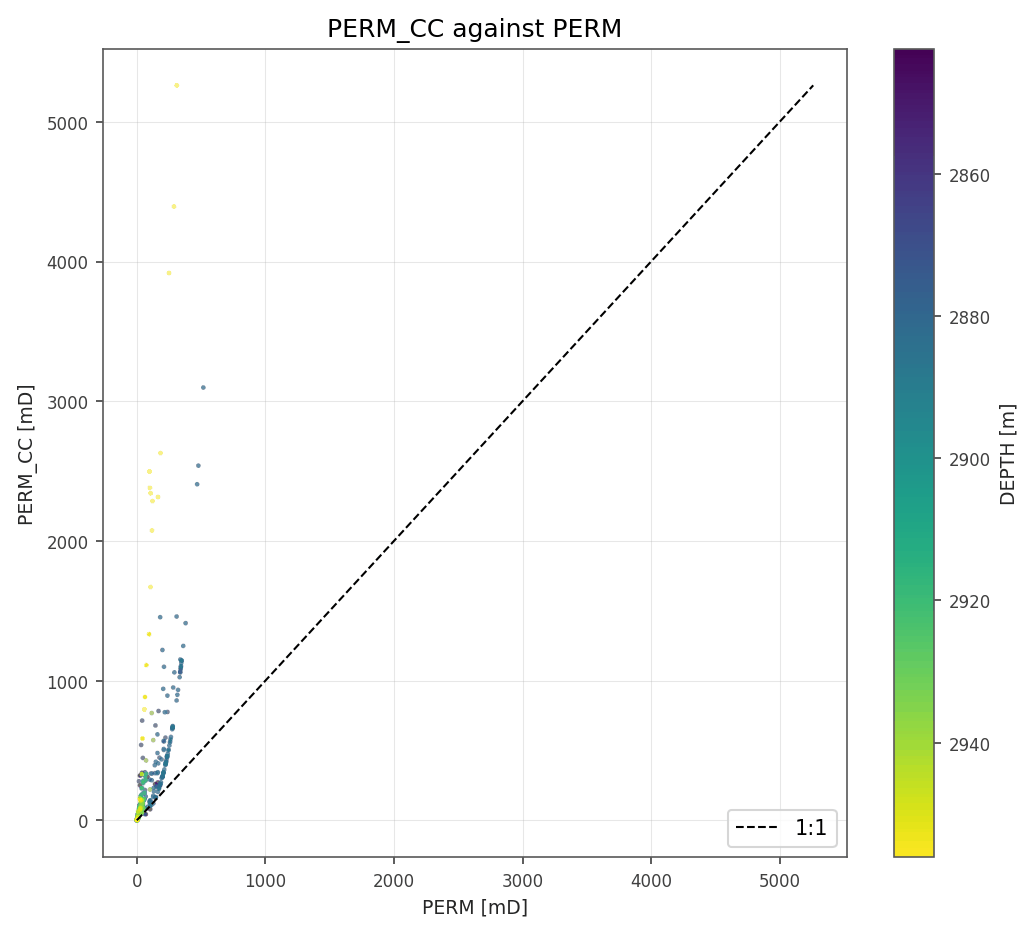
#  'caption': 'Figure 1. Crossplot of PERM_CC [mD] against PERM [mD] (zones Z1, Z4, Z5, Z6, Z7, Z9, Z13, Z14, Z15,
#              Z18, Z19, Z20), with the 1:1 line; 343 samples. Drawn by Petrophys (pp.crossplot) from result E17.',
#  'file': 'figures/figure_1_crossplot.png', 'samples': 343}
[(b["step"], b["why"]) for b in second.basis][:4]
# [('normalization', 'named'), ('vclay', 'named'), ('porosity', 'named'), ('core_correction', 'named')]
Fields of Turn
| Field | Type | Default | Meaning | Defined in |
|---|---|---|---|---|
number |
int | required | The question's number, from 1. | session. |
question |
str | required | The question as asked. | Turn |
answer |
str | required | The answer as delivered. | Turn |
status |
str | required | ok, unresolved_numbers, error: <type> or error: empty answer (the writer's last draft was empty). |
Turn |
trace |
dict | required | The question's trace: as AskResult.trace without setup_parts (the session log's setup event holds the parts), plus basis, figures and, after a settings change, settings. |
session.graph |
folder |
Path | required | turns/NN. |
Turn |
figures |
list | [] |
The figures drawn: id, kind, source, spec, caption, file (relative to folder), samples. |
figures.attach |
basis |
list | [] |
The steps the answer rests on: step, method, curves, inputs, parameters, why (named or upstream). |
basis.used |
ok |
property, bool | - | True unless status starts with error. |
Turn.ok |
trace["figures"]is the whole figure record:candidates,chosen,figures,errors,usage. At most 3 figures are drawn per answer (figures.).MAX_ FIGURES
SessionLog
SessionLog reads and appends the events of log.jsonl and keeps the texts they name under blobs/.
| Member | Returns | Arguments (defaults) | Meaning | Defined in |
|---|---|---|---|---|
SessionLog(folder) |
SessionLog | folder |
Opens the log; creates blobs/ when missing. |
session. |
append(kind, turn=0, /, **data) |
dict | kind, turn positional |
Appends {seq, time (UTC), turn, type, **data}. |
SessionLog.append |
events(kind=None) |
list | kind: an event type |
Every event, or those of one type. | SessionLog.events |
blob(text) |
str | text |
Keeps a text once under its SHA-256 and returns the hash. | SessionLog.blob |
read(sha) |
str | sha |
A kept text. | SessionLog.read |
from petroharness.session.log import SessionLog

log = SessionLog("brent-session")
[e["type"] for e in log.events()][:5]          # ['session_start', 'display', 'setup', 'question', 'result']
r = log.events("result")[0]
print(r["id"], r["tool"], log.read(r["sha256"])[:40])     # E1 stats Each zone, every curve (its mean; a flag
- Event types:
session_start,setup,display,question,result,record,figure,turn_end,settings,zones,scope,frame,session_resume(Conversations, Audit an answer).
7. Prepared questions and benchmark mode
Benchmark mode and scripts run prepared questions (Tasks from a question file) through cli.answer(), or as a
conversation with Conversation.. A task carries the question, the well and the interval; the evaluation
index stays outside it.
cli.answer
answer() runs one prepared task through the question graph, as benchmark mode does.
petroharness.cli.answer(task, model_key: str, rep: int, max_steps: int, writer: str = "", fmt: str = "profile",
                        direct: bool = True) -> dict
| Argument | Type | Default | Meaning | Defined in |
|---|---|---|---|---|
task |
petroharness. |
required | The question, well, interval and LAS path. | cli.answer |
model_key |
str | required | A key of petroharness.. |
agent. |
rep |
int | required | The repetition; with the task id, it picks the endpoint. | agent. |
max_steps |
int | required | The step cap. | cli.answer |
writer |
str | "" |
"open" allows two repair rounds, "" one. |
cli.answer |
fmt |
str | "profile" |
"profile" (the report style's format) or "default" (the writer's own). |
cli.answer |
direct |
bool | True | The direct route; False gives the full investigation. | cli.answer |
import os
os.environ["PETROHARNESS_DATA"] = "/path/to/data.yaml"            # read when the task's configuration is built
from petroharness.cli import answer
from petroharness.config import HarnessConfig
from petroharness.models import register
from petroharness.tasks import load_tasks

cfg = HarnessConfig()
tasks, index = load_tasks(cfg.eval.questions, cfg.data.las_dir)
key = register(["http://localhost:8000/v1"], model="Qwen/Qwen3-32B")
out = answer(tasks[0], key, 1, 8, writer="open")
print(out["status"], out["answer"][:200])
- The data settings are those in force:
config.when set, else the data config file (Configuration).given_ settings(...) - The trace's
commitiscli.COMMIT, read once whenpetroharness.cliis imported (core.): the checkout's short commit, withsetup. harness_ commit +dirtywhensrc/has uncommitted changes; "" for an installed package. - The trace names the setup it answered under, with
modetasks:setup(the hash) andsetup_parts(the record).
cli.main, cli.benchmark and cli.save
These are the console script and benchmark mode's runner.
| Function | Returns | Arguments (defaults) | Meaning | Defined in |
|---|---|---|---|---|
main() |
int or None | reads sys.argv |
Dispatches to a command (Command line). | cli.main |
benchmark(argv=None) |
None | argv: arguments |
Benchmark mode (Command line); prints and writes the summary. | cli.benchmark |
save(prefix, model_ |
None | gt_dir: the reference folder (None: runs/) |
Writes each group's traces, responses file and reference subset under runs/. |
cli.save |
from petroharness.cli import benchmark
benchmark(["--arm", "run1", "--ids", "ids.json", "--gt-dir", "/path/to/references", "--model", "Qwen/Qwen3-32B"])
Task and load_tasks
Task (a pydantic model) is a question as the harness sees it, and load_tasks() reads a question file into tasks.
| Field | Type | Default | Meaning | Defined in |
|---|---|---|---|---|
task_id |
str | required | Opaque id (opaque_id(qa_id): t + 10 hex digits). |
tasks.Task |
question |
str | required | The question. | tasks.Task |
well |
str | required | The LAS file's stem. | tasks.Task |
formation |
str | required | The top name, or the interval's name. | tasks.Task |
las_path |
Path | required | The LAS file. | tasks.Task |
top, base |
float or None | None | An explicit interval; without one a tops table is needed. base None runs to the end of the log. |
tasks.Task |
depth_unit |
str or None | None | Unit of top/base: None is metres, "las" the LAS's own, or m/ft. |
tasks.Task |
base_closed |
bool | False | A stated base is included; a base that is the next top is not. | tasks.Task |
formation_ |
str or None | None | The formation's lithology as the data states it (upper case). | tasks.Task |
A question file of two rows, one a formation of a tops table, one a depth interval:
[{"qa_id": "q0001", "question": "What is the mean effective porosity of the Brent Group?", "las_path": "30_6-5.las",
  "formation": "BRENT GP.", "category": "porosity"},
 {"qa_id": "q0002", "question": "What is the mean core porosity of the cored interval?", "las_path": "25_5-1.las",
  "formation": {"name": "cored interval", "top": 2990, "base": 3290}, "category": "porosity"}]
from petroharness.tasks import load_tasks
tasks, index = load_tasks("questions.json", Path(petrophys.sample("30/6-5")).parent, categories=["porosity"])
tasks[1].formation, tasks[1].top, tasks[1].base, tasks[1].depth_unit, tasks[1].base_closed
# ('cored interval', 2990.0, 3290.0, 'las', True)
index[tasks[0].task_id]          # {'qa_id': 'q0001', 'category': 'porosity'}
load_returnstasks(questions_ file, las_ dir, categories=None) (tasks, index); the index (qa_id,category) is for scoring only and never reaches a task. The row format: Command line.
8. Evidence, audit and report
EvidenceGraph
EvidenceGraph is a conversation's evidence graph, rebuilt from its log.jsonl and blobs/ alone, with no well, no
Petrophys and no model (Audit an answer). On the Brent conversation:
from petroharness.evidence import EvidenceGraph

g = EvidenceGraph.from_log("brent-session")
g.questions()                    # [1, 2]
t = g.trail(1)
sorted(t)
# ['answer', 'claims', 'curves', 'figures', 'las', 'numbers', 'question', 'results', 'session', 'settings', 'steps']
t["numbers"]["0.125"]            # ['E1', 'E9', 'E10']: the results that show this number of answer 1
g.out("C1.1", "cites")           # ['E2', 'E1', 'E8', 'E9', 'E10']: the results claim 1 of answer 1 cites
g.out("A1", "carries")           # ['F1.1', 'F1.2', 'F1.3']: the answer's three figures
Members of EvidenceGraph
| Member | Returns | Arguments (defaults) | Meaning | Defined in |
|---|---|---|---|---|
nodes |
dict | - | {id: {"kind": ..., ...}}; ids las, session, curve:<NAME>, step:<name> (@gen<k> after a settings change), Q<n>, E<k>, A<n>, C<n>.<k>, F<n>.<k>. |
evidence. |
links |
list | - | {"kind", "from", "to", ...}; kinds from, computed_by, reads, opened, answered_by, states, cites, shows (with numbers), carries, draws. |
EvidenceGraph |
from_log(folder) |
EvidenceGraph | folder |
Builds the graph; the same log always gives the same graph. | EvidenceGraph. |
questions() |
list of int | none | The question numbers. | EvidenceGraph. |
out(nid, kind=None), into(nid, kind=None) |
list | kind: a link kind |
The ids a node links to, or that link to it. | EvidenceGraph.out, into |
upstream(curves) |
(list, list) | curves: curve node ids |
The curves and steps those curves rest on, back to the measured logs. | EvidenceGraph. |
trail(n) |
dict | n: question number |
Everything answer n rests on; raises KeyError when it has no answer. |
EvidenceGraph. |
to_json() |
dict | none | {"nodes", "links"} in a fixed order. |
EvidenceGraph. |
node(nid, kind, **data), link(kind, src, dst, **data) |
str, None | building | Add a node or a link (a link needs both ends and is kept once). | EvidenceGraph.node, link |
What trail(n) holds
question(n,text),answer(status,sha256,opening),claims(id,text,grade,results),numbers({number: [ids]}),results(id,tool,args,sha256,question,curves),curves(name,unit,source,step,named),steps(step,method,parameters,reads),settings(the changes made up to questionn),figures,las,session.- A question with no answer raises
KeyErrornaming the questions there are:g.trail(5)on the Brent conversation gives'WHAT: question 5 has no answer in this conversation. FIX: one of [1, 2].'
audit and report functions
These functions write the audit trail and the conversation document that petroharness audit and
petroharness report print.
| Function | Returns | Arguments (defaults) | Meaning | Defined in |
|---|---|---|---|---|
audit. |
str | g: EvidenceGraph, n: question |
The trail of answer n as Markdown (Command line). |
evidence. |
audit. |
int | arguments | The audit command. |
evidence. |
report. |
str | folder: session folder |
The whole conversation as one document (Command line). | evidence. |
report. |
int | arguments | The report command. |
evidence. |
links. |
dict | items: ledger items |
{number as written: [result ids]}, at most 300 numbers (MAX_NUMBERS); whole numbers below 20 are skipped. |
evidence. |
record. |
dict | inv: the inventory |
The well's record as {"curves", "steps"}, at most 24 parameters a step (MAX_PARAMETERS). |
evidence. |
record. |
list | named: curve names |
The steps behind the named curves and those they read from. | evidence. |
basis. |
list | s: a live session |
The steps and parameters an answer rests on (Turn.basis). |
basis.used |
basis. |
str | rows | The "Methods and parameters this answer rests on" section ("" for none). | basis.markdown |
from pathlib import Path
from petroharness.evidence import EvidenceGraph, audit, report

g = EvidenceGraph.from_log("brent-session")
Path("trail-1.md").write_text(audit.markdown(g, 1))                         # '# Audit trail: question 1' ...
Path("brent-session/report.md").write_text(report.markdown("brent-session"))   # '# Conversation report: 30_6-5.las' ...
9. Setup
A Setup is what a run is made of: the harness and Petrophys builds, the prompt components, the skill library, the
model and the hashes of its card, the data settings and the policy (Audit an answer).
Two runs under the same setup have the same 12-character hash.
from petroharness.config import given_settings
from petroharness.core import setup

cfg, given = setup.config_for(model="Qwen/Qwen3-32B")
with given_settings(given):
    s = setup.of(cfg)
print(s.model, s.max_steps, s.mode, len(s.hash()))      # Qwen/Qwen3-32B 8 interactive 12
cfg2, given2 = setup.config_for()                         # the default card
with given_settings(given2):
    print(setup.differences(s.to_dict(), setup.of(cfg2).to_dict()))      # ['card', 'model']
Setup
Setup is the frozen dataclass of what a run is made of.
| Field | Type | Default | Meaning | Defined in |
|---|---|---|---|---|
harness |
str | required | The package version (1.3.1). |
core.setup.Setup |
commit |
str | required | The checkout's short commit, +dirty when src/ has changes; "" for an installed package. |
harness_commit |
petrophys |
str | required | The Petrophys build (version and commit, or a hash of its installed files). | well. |
components |
dict | required | Prompt component (C1 ... C10) -> version. |
agent. |
functions |
str | required | Hash of the Petrophys functions the tools offer. | functions_hash |
skills |
dict | required | {"library", "version"}. |
agent. |
model |
str | required | The served model's name. | Setup |
card |
str | required | Hash of the card's request settings, without base_url, api_key_env, timeout_s, max_retries, label, model. |
of |
data |
str | required | Hash of the data settings, without las_dir, tops_csv, cache_dir, engines_dir, lithology_. |
of |
policy |
str | required | First 12 hex digits of the policy file's SHA-256. | of |
writer, fmt, max_steps |
str, str, int | required | Repair rounds, answer format, step cap. | Setup |
mode |
str | required | interactive or tasks. |
Setup |
depth |
bool | required | The direct route is on. | Setup |
Setup functions
These functions build, compare and print setup records.
| Function | Returns | Arguments (defaults) | Meaning | Defined in |
|---|---|---|---|---|
of(cfg, *, writer="open", fmt="profile", max_ |
Setup | cfg: a HarnessConfig with its card applied |
The setup a configuration answers under; max_steps None records 8. |
core.setup.of |
config_ |
(HarnessConfig, dict) | as listed; settings None: PETROHARNESS_DATA, else none |
The configuration a question would run under with no well, and the settings to run of() under. |
core. |
for_well(args) |
Setup | the parsed petroharness setup arguments, with las |
The setup a question about the interval of args.las answers under: the data settings built from the LAS as ask() builds them (interval.prepare), the configuration as each question's (agent.). |
core. |
Setup.hash() |
str | none | 12 hex digits of the SHA-256 of the sorted JSON record. | Setup.hash |
Setup.to_dict() |
dict | none | The record. | Setup.to_dict |
differences(a, b) |
list | two records (dicts) | The parts that differ ("card", "components.); [] for the same setup. |
core. |
text(s) |
str | a Setup | The record as petroharness setup prints it. |
core.setup.text |
harness_commit() |
str | none | The checkout's short commit when the package's own source files are tracked there (+dirty when src/ has uncommitted changes), else "". |
core. |
functions_hash() |
str | none | The hash of the registry of Petrophys functions, the same in every process (defaults written by stable_repr: sets and dict keys sorted, object addresses dropped). |
core., core. |
main(argv=None) |
int | arguments | The setup command. |
core.setup.main |
Two conversations compared by the last setup each logged:
import json
from petroharness.core import setup

def last_setup(folder):
    rows = [json.loads(x) for x in open(f"{folder}/log.jsonl") if x.strip()]
    e = [r for r in rows if r["type"] == "setup"][-1]
    return {k: v for k, v in e.items() if k not in ("seq", "time", "turn", "type", "hash")}

setup.differences(last_setup("session-a"), last_setup("session-b"))     # [] when both ran under the same setup
10. Interpretation settings and field notes
petroharness. lists and checks the interpretation settings, the names interpretation=, adopt(),
/set and field notes use; petroharness. reads a field notes file. Each setting in detail:
Interpretation settings.
from petroharness.well import settings as T
T.validate({"m": "high", "zone_vcl_bands": [0.6, 0.3], "bogus": 1})
# {'m': 'give a number', 'zone_vcl_bands': 'give two edges between 0 and 1, the first below the second',
#  'bogus': 'not a setting this panel knows'}
T.validate({"rw": 0.05, "sw_model": "indonesia", "m": 2.2, "zone_min_thickness_m": 1.0})     # {}
T.split({"m": 1.8, "zone_min_thickness_m": 1.0})      # ({'m': 1.8}, {'zone_min_thickness_m': 1.0})
petroharness.well.settings
These functions list, check and describe the interpretation settings.
| Function | Returns | Arguments (defaults) | Meaning | Defined in |
|---|---|---|---|---|
schema() |
dict | none | {"groups": [{"key", "title", "about", "fields": [...]}], "petrophys": build}; each field has key, label, kind (number, integer, switch, choice, bands, text), unit, choices, default, help, more, common, petrophys, heading (the zone fields add length or choice_labels). |
well. |
validate(settings) |
dict | settings |
{setting: what is wrong}; empty when all can be used. A refusal by Petrophys that names no setting is under _petrophys. |
well. |
split(settings) |
(dict, dict) | settings |
(Petrophys's options, the zone rule's data settings). | well. |
used(prep) |
dict | a prepared well | {setting: {"value", "step"}} read from the step record (with unit where the step records one); section 4 reads it on Teapot 17-WX-21. |
well.settings.used |
merged(in_ |
dict | two dicts | The settings after a change; None removes a setting. |
well. |
diff(before, after) |
list | two dicts | [{"key", "from", "to"}] for each setting that differs. |
well.settings.diff |
describe(changes) |
str | a diff | The change in words, as the log, the prompts and the answer's header name it. | well. |
values(settings) |
str | a dict | The settings as values in words. | well. |
d = T.diff({"m": 2}, {"m": 1.8, "rw": 0.04})
# [{'key': 'm', 'from': 2, 'to': 1.8}, {'key': 'rw', 'from': None, 'to': 0.04}]
T.describe(d)                                  # 'm 2 -> 1.8; rw the default -> 0.04'
T.values({"m": 1.8, "sw_cutoff": 0.6})         # 'm 1.8; sw_cutoff 0.6'
petroharness.well.notes
These functions read a field notes file and say how its notes reach the model.
| Function | Returns | Arguments (defaults) | Meaning | Defined in |
|---|---|---|---|---|
load(path) |
dict | path |
{"path", "sha256", "name", "settings", "notes"}; raises with the entry and the fix (Configuration): FileNotFoundError for a missing file, ValueError for anything else wrong, such as more than 20 notes or a note over 300 characters. |
well.notes.load |
statement(notes) |
str | loaded notes | (The user's field notes for this field, <name>: <notes>), added to every question; "" with no notes. |
well. |
sources(in_ |
dict | as listed | {setting: "field notes" or "user"}. |
well.notes.sources |
# north.yaml
name: North field study
settings:
  m: 1.8
  sw_cutoff: 0.6
notes:
  - Report water saturation from the Indonesia model.
  - Call the upper sand the A sand.
from petroharness.well.notes import load, sources, statement
n = load("north.yaml")
print(n["name"], n["settings"])          # North field study {'m': 1.8, 'sw_cutoff': 0.6}
statement(n)
# "(The user's field notes for this field, North field study: Report water saturation from the Indonesia model.
#  Call the upper sand the A sand.)"
sources({"m": 1.8, "sw_cutoff": 0.6, "rw": 0.04}, n)
# {'m': 'field notes', 'sw_cutoff': 'field notes', 'rw': 'user'}
11. Model clients and tapes
Every model call goes through one client, built by llm_factory(cfg) from the question's HarnessConfig; the
default is petroharness.. A tape records the requests and replies at that boundary, so a recorded
conversation can be replayed with no model server. The public mini set does so on the Brent Group (run from the
repository root, with PETROHARNESS_DATA and PETROHARNESS_ unset, on the Petrophys build it was recorded
with):
import petrophys
from petroharness import tape
from petroharness.llm import LLM
from petroharness.session import Conversation

replayer = tape.Replayer(tape.load("tests/gate/mini/brent/turns/01.tape.jsonl"))

def factory(cfg):                       # the harness's own client, answered from the recording
    llm = LLM(cfg)
    llm.client.chat.completions.create = replayer
    return llm

c = Conversation.start(petrophys.sample("30/6-5"), "mini-session", formation="BRENT GP.",
                       tops=petrophys.sample("formations_30_6-5.csv"), llm_factory=factory)
turn = c.ask("What are the porosity and water saturation of the Brent Group, and is any of it hydrocarbon-bearing?")
print(turn.status, replayer.left())     # ok 0
The model client contract
| Member | Type | Default | Meaning | Defined in |
|---|---|---|---|---|
chat(stage, messages, usage, max_ |
method -> str | required | One completion: the reply text. usage is a petroharness.. |
llm.LLM.chat |
set_light(on) |
method | optional | Switches the card's light thinking setting on or off (used for the figures call). | agent.graph._light |
client. |
attribute | LLM only |
The OpenAI SDK call; tapes wrap it. | llm.LLM.__init__ |
Tapes
petroharness.tape records and replays the requests and replies at the model boundary.
| Function | Returns | Arguments (defaults) | Meaning | Defined in |
|---|---|---|---|---|
record(llm, path) |
list | an LLM, a path |
Wraps the client: each call is sent and appended to path (JSON lines) and the list. |
tape.record |
load(path) |
list | a path | A tape; reads path.gz when only the compressed copy exists. |
tape.load |
Replayer(tape, collect=False) |
callable | a tape | Serves the recorded replies in order; a request that differs raises TapeMismatch (with collect, it is kept in .diffs). .left() counts calls not made. |
tape.Replayer |
replay(llm, tape, collect=False) |
Replayer | an LLM, a tape |
Installs a Replayer on the client. |
tape.replay |
from petroharness import tape
recorded = tape.load("brent-session/turns/01/tape.jsonl")
print(len(recorded), sorted(recorded[0]))        # 13 ['n', 'reply', 'request']
- A conversation records each question's tape to
turns/by itself when the client has the OpenAI SDK'sNN/ tape. jsonl client., aschat. completions LLMdoes.
12. Limits and errors
Wrong inputs raise before any model call (FileNotFoundError, ValueError, FormationNotFound). A failure while the
model answers never raises: the status says error: <type> and the trace holds error and traceback. A failed
figure or projection costs nothing but itself.
Every error, what happens and where
| Situation | What happens | Where |
|---|---|---|
| No LAS file at the path | FileNotFoundError |
ask.ask, Conversation.start |
| An empty question | ValueError |
ask.ask, Conversation.ask |
No endpoint and no llm_factory |
ValueError naming PETROHARNESS_ |
ask._model_key |
| Unknown or bad model card | ValueError |
models.card_file, models. |
| Wrong interval inputs (tops with depths, unit, base above top, a name the tops file lacks, a tops file that cannot be read as a table) | ValueError, or FormationNotFound (LookupError) |
interval._interval, well.tops |
| The interval has no samples, or the named lithology curve has no data | ValueError |
ask.check |
A settings file that does not exist, a misspelt data key, or a data.interpret setting Petrophys does not have |
FileNotFoundError, or a pydantic ValidationError or another ValueError |
interval._settings, ask.check, well. |
| Petrophys cannot interpret the LAS | RuntimeError |
well.prepare |
| A bad skill library | LibraryError (a ValueError) before Petrophys interprets the well (ask(), Conversation.start, Conversation.) |
ask.check, agent. |
| Hosted tracing on | RuntimeError when petroharness. is imported, and again before each conversation question |
agent. |
| The model fails during a question | No exception: status is error: <type>; the trace holds error and traceback |
agent.graph.turn |
| The writer's last draft is empty | No exception: status is error: empty answer (the writer's last draft was empty); the trace's error says so |
agent. |
Conversation.start on a folder with a conversation |
ValueError |
Conversation._new |
Conversation. on a folder without one |
ValueError |
Conversation. |
adopt with a wrong setting, or Petrophys settings under a profile, or on prepared tasks |
ValueError; nothing changes |
Conversation.adopt |
ask on a conversation on prepared tasks |
ValueError (use ask_task) |
Conversation.ask |
EvidenceGraph. with no answer n |
KeyError naming the questions there are |
EvidenceGraph. |
| A figure or projection fails | No exception: said in the trace (figures.errors, projection_error) and the answer stands |
session.graph |
13. Related pages
- Command line: the commands built on these functions.
- Configuration: the data config, interpretation settings, environment variables,
HarnessConfig. - Evaluate a formation: a formation evaluation of your own well.
- Conversations: conversations, settings changes, field notes.
- The three graphs: the question graph, the later-question graph and the session graph.
- Audit an answer: the evidence graph and the setup record.
- Architecture: what a trace holds.
- Interpretation settings: each interpretation setting in detail.
- Testing: the tests and gates that use the tapes.