1. At a glance
What the Brent conversation left behind, and what is built from it:
flowchart LR
    one["One question<br/>petroharness --out DIR"]:::model --> a1["answer.md<br/>header and answer"]:::record
    one --> t1["trace.json<br/>steps, claims, checks, setup"]:::record
    one --> c1[".cache/<br/>the interpreted well"]:::code
    conv["A conversation<br/>petroharness chat --session DIR"]:::model --> log["log.jsonl<br/>32 events"]:::record
    conv --> blobs["blobs/<br/>21 texts named by SHA-256"]:::record
    conv --> turns["turns/01, turns/02<br/>answer, trace, tape, figures"]:::record
    conv --> ov["overview.png<br/>the interval display"]:::petrophys
    log --> eg["evidence graph<br/>153 nodes, 287 links"]:::code
    blobs --> eg
    eg --> audit["petroharness audit<br/>one trail per answer"]:::code
    eg --> report["petroharness report<br/>report.md"]:::code

    classDef model fill:#e6ecf4,stroke:#011e3f,color:#011e3f
    classDef record fill:#f0eeea,stroke:#9aa0aa,color:#1c2433
    classDef code fill:#ffffff,stroke:#9aa0aa,color:#1c2433
    classDef petrophys fill:#e3f2ee,stroke:#197e6f,color:#0f4f45
- A single question writes
answer.mdandtrace.json(with its setup record): no log, no tape. - A conversation keeps
log.jsonlandblobs/, every text once under its SHA-256; each question addsturns/NN/. - Every question runs under one 12-character setup hash.
- The evidence graph (built on demand, not stored), the audit trail and the report need only the log and the blobs.
2. How it works
flowchart TB
    q["question"]:::model --> open["open<br/>question event (setup event once)"]:::code
    open --> turn["turn: the question graph runs<br/>result events, record event"]:::code
    turn -- "answered" --> project["project<br/>basis, number links"]:::code
    turn -- "no answer" --> commit
    project --> figures["figures<br/>figure events, PNG files"]:::petrophys
    project -- "figures off" --> commit
    figures --> commit["commit<br/>answer.md, trace.json, turn_end event"]:::record

    classDef model fill:#e6ecf4,stroke:#011e3f,color:#011e3f
    classDef code fill:#ffffff,stroke:#9aa0aa,color:#1c2433
    classDef record fill:#f0eeea,stroke:#9aa0aa,color:#1c2433
    classDef petrophys fill:#e3f2ee,stroke:#197e6f,color:#0f4f45
- A single question (
ask.ask) runs the question graph (agent.graph.answer) and writes the two files; the trace'ssetupandsetup_partshold the setup record. - A conversation starts with
Conversation.start(session_start);petroharness chatdrawsoverview.png(Conversation.,overview display). - Each question runs the session graph (
session/graph.py):open_questioncreatesturns/NN/and logssetup(when it changed) andquestion;turnruns the question graph with a taped client and logs aresultper new ledger item and arecordwhen the well's record changed;projectreads the methods, parameters and number links off the answer;figureslogs afigureper figure;commitwrites the two files and logsturn_end. - A settings change (
Conversation.adopt) logssettings; a resume (Conversation.) rebuilds the ledger from theresume resultevents and logssession_resume.
3. The output folder of one question
ask. writes the answer, the trace and the cache; petroharness --out defaults to
./. For 30/6-5 with the default settings:
petroharness-out/30_6-5/
├── answer.md
├── trace.json
└── .cache/
    └── reference_v2_81e94bcb/
        └── 30_6-5__full_well__5ecf2c53826981f9.pkl
With out=None (the Python default) nothing is written and the cache goes to a temporary folder.
Folder contents
| Entry | Type | Present | Meaning | Defined in |
|---|---|---|---|---|
answer.md |
file | always | The header and the answer (section 4); no figures and no methods section | ask.py, _answer_md |
trace.json |
file | always | The trace (section 5), with answer, ask, setup and setup_parts; no basis, figures or session keys |
ask.py, ask; agent/graph.py, answer |
.cache/ |
folder | always | The interpreted well, reused by a later run on the same LAS and settings | well/prepare.py, _cache_path |
The cache path is <cache_: 8 hex of a hash of the
policy's interpretation keys, the interpretation version and the Petrophys build (with the engine, a named lithology
curve, a data interpreter and the interpret options when given), and the start of the LAS file's SHA-256, so a
revised LAS under the same name never reuses a cached well.
4. answer.md
The header says what was asked and how the interval was read; a rule ends it; the answer follows, then, in a
conversation, its figures and the methods and parameters it rests on. The Brent conversation's turns/01/answer.md,
cut:
# 30_6-5: BRENT GP.
- **Question:** What are the porosity, water saturation and permeability of the Brent Group, and is any of it hydrocarbon-bearing?
- **Interval:** 2841-2958 m (768 samples; tops file formations_30_6-5.csv, base: stated base)
- **Lithology:** zones from the lithology log LITHOLOGY_GEOLINK (detected)
- **Model:** K2-Horizon-7B
- **Skill library:** researched (version 18c03ad5d3f8)
- **Status:** ok, 8 investigation steps
---
# Brent Group, Well 30_6-5 — Porosity, Saturation, Permeability and Hydrocarbon Potential
...
## Figures

...
## Methods and parameters this answer rests on
Read from the well's record, not written by the model. The steps that computed the curves this answer names:
- **net_pay**: cutoff_flags. computed NET_PAY, PRIME_OIL_TARGET. read VCL, PHIE_CC, SW. parameters vcl_cutoff = 0.3; phie_cutoff = lithology_dependent; sw_cutoff = 0.7; ...
...
A well without a lithology log is zoned by the lithology Petrophys's mineral solver gives, and its header says so: Taranaki tuhua-7, McKee (Data: Taranaki Basin Curated Well Logs Dataset (New Zealand Petroleum & Minerals), CDLA-Sharing-1.0.), written by the header code for the prepared interval. No model ran, so there is no status and no answer:
# tuhua-7: McKee

- **Question:** What are the porosity and water saturation of the McKee Formation, and is any of it hydrocarbon-bearing?
- **Interval:** 1935.02-2017.78 m (544 samples; tops file formations_tuhua-7.csv, base: stated base)
- **Lithology:** no lithology log: lithology zones from Petrophys's mineral solver (LITHO, clastic domain, canonical multi mineral solver)
- ...
Layout
| Part | Type | Present | Content | Defined in |
|---|---|---|---|---|
| Header | Markdown list | interactive runs | Title, question, interval, lithology, model, skill library, status and route, field notes, settings changes (Writer and checker) | ask.py, _answer_md |
--- |
rule | always | Ends the header | ask.py, _answer_md |
| Answer | Markdown | always | The delivered answer, or (no answer: <error or status>) |
agent/graph.py, delivered |
## Figures |
section | conversation, at least one figure drawn | Each figure as a Markdown image of figures/ with its caption as the alt text, then the caption in italics |
figures.py, markdown |
## Methods and parameters this answer rests on |
section | conversation, the answer names a computed curve | The steps behind the curves the answer and its cited results name (below), then The steps those read from: |
basis.py, markdown |
- A conversation on prepared tasks writes
**Question N:** <question>,---and the answer instead of the header. - Each methods line is
**<step>**: <method>. computed <curves>. read <inputs>. parameters <k> = <v>; ...(basis.line); a float is written with:.6g, a boolean asyesorno.
Methods and parameters rows
basis. returns the rows; they are also trace.basis and Turn.basis. Defined in
evidence/record.py.
| Field | Type | Default | Meaning | Defined in |
|---|---|---|---|---|
step |
str | none | The workflow step's name | behind |
method |
str | computed on request in this conversation for a curve computed on request |
The method the step recorded | behind |
curves |
list of str | the step's first 6 outputs | The named curves it computed | behind |
inputs |
list of str | [] |
What the step read, as recorded | behind |
parameters |
object | {} |
Its scalar parameters (section 10) | parameters |
why |
str | none | named: it computed a curve the answer or a cited result's call names; upstream: a named step reads from it, however far back |
- |
{"step": "bad_hole", "method": "caliper_drho_flags", "curves": ["BAD_HOLE"], "inputs": ["CALI", "BS", "DRHO", "RHOB", "PEF"],
 "parameters": {"cali_minus_bs_threshold_in": 1.5, "...": "..."}, "why": "named"}
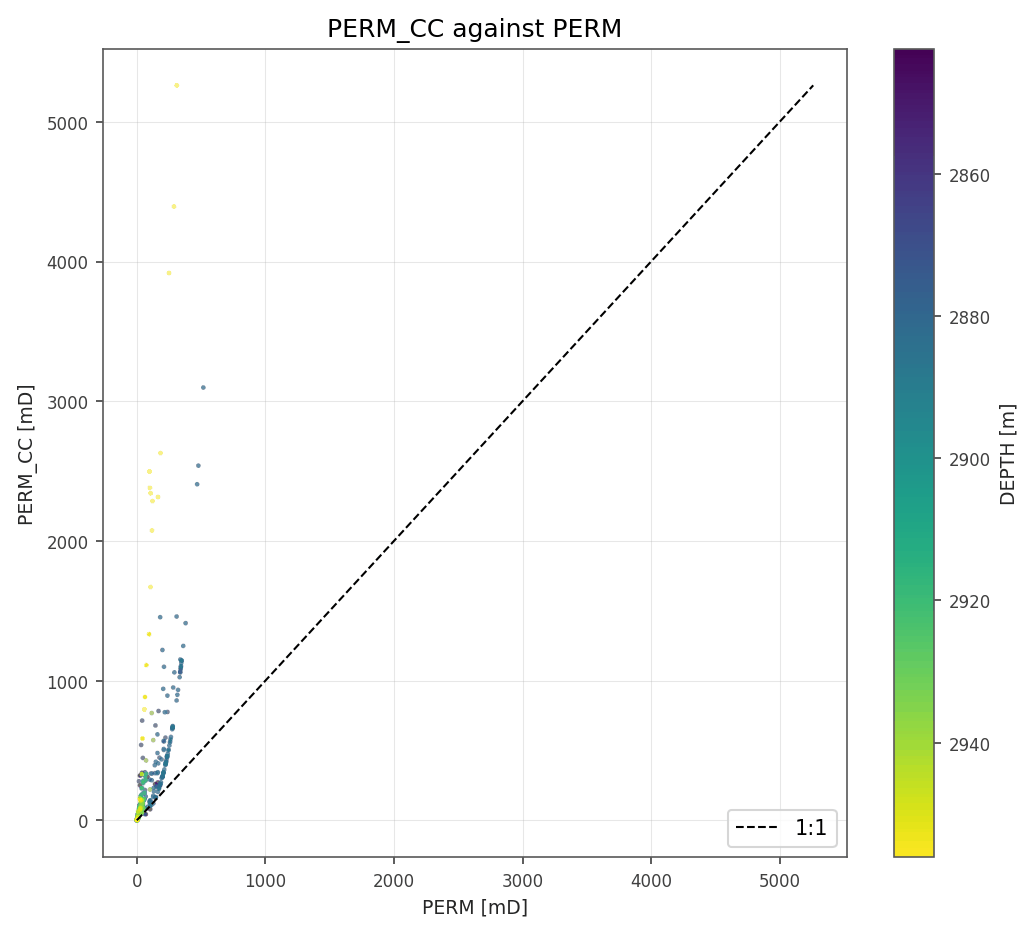
Each figure is a PNG beside the answer, drawn by Petrophys and logged in a figure event (section 7):
5. trace.json
The trace is one JSON object per question, written with json. by ask.ask, the
session graph's commit or cli.benchmark. Each block below lists every key of one group and when it exists.
Run identity
Set in agent/graph.py unless noted.
| Key | Type | Present | Meaning | Set by |
|---|---|---|---|---|
task_id |
str | always | The task's id: a + 10 hex of SHA-256 over the LAS path, question and interval (and |question N for N > 1) for interactive runs; t + 10 hex for prepared tasks |
interval.py, task_for; tasks.py |
well |
str | always | The LAS file's stem | turn |
formation |
str | always | The interval's name | turn |
harness |
str | always | petroharness <package version> (agent., from petroharness.) |
turn |
commit |
str | always | The harness commit (cli.COMMIT = core.): the short commit when core/setup.py is a tracked file, with +dirty when src/ has changes; "" for an installed package |
cli.py; core/setup.py, harness_commit |
model |
str | always | The model's name as people read it (graph.public_model): --model, else the card's label, else the card's served name; never the registry key or the endpoint URLs |
turn, public_model |
skills |
object | always | {"library": <name>, "version": <hash>}, or {"library": "none", "version": null} |
agent/direction.py, stamp |
components |
object | always | Each prompt component's version, C1 to C10: 12 hex of SHA-1 over its files and the code it frames |
agent/, versions |
reads_depth |
bool | always | Whether the READ call was asked if the question is direct (false with --investigate) |
turn |
options |
object | after the investigation | The switches in force (options.py); {} when none is defined |
close |
status |
str | always | ok, unresolved_numbers, ask_user (asked back, nothing computed), outside (a request outside what the harness does), stopped (its user stopped it: no answer, and stopped: true in the trace), error: empty answer (the writer's last draft was empty) or error: <exception type> |
turn, finalize, answer_status |
seconds |
float | always | Wall time of the question graph, to 0.1 s | turn |
error, traceback |
str | the run failed | <type>: <message>, and the last 4,000 characters of the traceback; for an empty answer only error, the writer's last draft was empty |
turn, finalize |
answer |
str | always | The delivered answer | ask.py, session/graph.py, cli.py |
{"task_id": "a2f8275dd57", "well": "30_6-5", "formation": "BRENT GP.", "harness": "petroharness 1.3.1",
 "commit": "<commit>", "model": "K2-Horizon-7B", "skills": {"library": "researched", "version": "18c03ad5d3f8"},
 "components": {"C1": "6f8f4c39893a", "...": "..."}, "reads_depth": true, "status": "ok", "seconds": 903.5}
Reading and first look
Set in agent/graph.py unless noted.
| Key | Type | Present | Meaning | Set by |
|---|---|---|---|---|
map_chars |
int | always | Length of the map, set after build and after the READ call |
build, read_step |
read |
object | always | The READ call: reply (first 3,000 characters), parse (ok, retry, failed), topics, named, and depth when asked (direct or investigate; outside for a request outside what the harness does). reply keeps the word as the model wrote it |
agent/read.py, read_question |
topics |
list of str | always | The topic areas the model chose (at most 4; [] when unreadable, or when the model named none: a request outside what the harness does needs none) |
agent/read.py, read_question |
absent |
list of objects | always | {"name", "curves"} for each measurement the question names with no data here |
first_look |
overview |
str | a first look ran | The first look's call, as stats {"curves": [...]} |
first_look |
depth |
object | a direct question went to an investigation | {"read": "direct", "investigated_ from a look step, or {"read": "direct", "investigated_ |
look, write_brief |
scope |
object | a question with a tops file, zones or depth ranges to choose from | The stretches the READ named (read), those used (used), the reason when none could be (note), the units merged (merged); by: "user" when the user's scope stood in, frame when the answer is framed by your zones |
agent/read.py, read_question |
read_scope_again |
object | the READ named no usable stretch | The second READ call, asked once with the reason: reply (first 1,500 characters), scope, note |
agent/read.py, read_question |
scope_chosen |
list | the question answers a question back | The stretches the user chose, used whatever the READ reads | agent/read.py, read_question |
ask_user, ask_choices |
str, list of objects | the question was asked back | The question back, and its choices ({"label", "question"}, with scope where a choice is a stretch); nothing was computed (status ask_user) |
agent/read.py, read_question |
outside |
bool | the request is outside what the harness does | true; the answer says what the harness does, with example questions (status outside) |
agent/read.py, read_question |
question_notes, reader_notes |
str, list of objects | the question names something the record lacks | The note the model is shown under the question, and the same as data for the answer's reader ({"kind": "absent" or "empty", "name", "curves", ...}; agent/, facts) |
first_look |
"read": {"reply": "...", "parse": "ok", "topics": ["porosity", "water_saturation", "permeability_rock_quality", "hydrocarbon_detection"],
         "named": ["porosity", "water saturation", "permeability", "Brent Group", "hydrocarbon-bearing"], "depth": "investigate"}
Investigation
Set in agent/graph.py unless noted.
| Key | Type | Present | Meaning | Set by |
|---|---|---|---|---|
steps |
list of objects | after the investigation | One record per step (Step records), look steps included | close |
points |
list of str | after the investigation | The question's points (at most 6, each at most 240 characters) | close |
intent |
str | after the investigation | value, locate, characterize, compare, explain or qc_check |
close |
guides |
list of str | after the investigation | The skill guides read, in order | close |
opened |
list of pairs | after the investigation | [id, call text] for every item in the ledger, earlier questions' included |
close |
errors |
list of str | after the investigation | Each rejected tool call's message, first 200 characters | close |
claims |
list of objects | claims exist | The claims in force (Claim records), after settle when it ran |
close; agent/settle.py, settle |
dropped |
list of objects | claims exist | The claims dropped, same fields | close; agent/settle.py, settle |
done_issues |
list of str | claims exist | What the done rule still finds: points without a settled claim, hypotheses left, flagged claims | agent/claims.py, done_issues |
settle |
object | the settle step ran | The settle record (below) | agent/settle.py, settle |
Question 1: "opened": [["E1", "stats PHIT, PHIE, ..."], ...], "done_.
Step records
Each entry of steps is one step of the investigation, or one look step of a direct question. Set in
agent/graph.py unless noted.
| Field | Type | Present | Meaning | Set by |
|---|---|---|---|---|
step |
int | always | The step number k | ask, look |
direct |
bool | look steps | true for a look step |
look |
prompt_chars |
int | always | Characters of the system and user messages | ask, look |
prompt_tokens |
int or null | always | Prompt tokens of the step's own call (its retry when the first reply was empty), not of a syntax-fix call | ask, look |
reply |
str | always | The reply, first 6,000 characters | ask, look |
repaired |
object | the reply was not one readable JSON object | error (200 characters), broken (the reply, 20,000 characters), by: salvage, fix or salvage, incomplete |
agent/replies.py, parse |
asks |
str | step 1 | What the question asks (point 1) | plan |
points_asked |
bool | step 1, when the points were asked for in an extra call | Whether that call gave them | plan |
focus |
str | readable steps | The step's focus, first 300 characters | decide |
edits, edit_msgs |
list | readable steps | The claim edits as sent, and a message for each edit that could not be applied | decide |
actions |
list of str | readable steps | The actions run, as action_text (stats {...}, get E5 Z3, guide porosity) |
decide, look |
guide_sections |
list of str | readable steps | Sections and stats a guide read the first time opened | decide |
unread |
list of str | an action could not be read | Each unreadable action as JSON, 200 characters | decide, look |
done, done_issues, held_done |
bool, list, list | as set | Whether the model set done; the done rule's issues; results withheld when done was set | decide |
withheld, carried, guides_read |
lists | after actions ran | Results left out of NEW for its budget; withheld results shown now; guides read | act |
new_chars |
int | after actions ran | Characters of the next NEW block | act |
stopped |
str | converged | converged after POLISH_STEPS = 2 steps that only rephrased |
act |
answer |
str | readable steps | The claims as rendered after the step | decide, act |
error |
str | unreadable | unreadable reply |
skip |
over_cap, to_investigation |
int, str | look steps | Lookups beyond DIRECT_ACTIONS = 4; why the question went to an investigation |
look |
Step 1 of question 1, whose reply was salvaged (cut):
{"step": 1, "repaired": {"error": "the reply is not one readable JSON object (cut off, or invalid syntax: ...)", "broken": "...", "by": "salvage"},
 "prompt_chars": 62799, "prompt_tokens": 18149, "actions": ["guide net_reservoir_pay", "section {\"key\": \"net_pay_flag_analysis\"}", "..."],
 "done": false, "withheld": [], "carried": [], "new_chars": 9652}
Claim records
Each entry of claims and dropped is a Claim as __dict__. Defined in agent/claims.py.
| Field | Type | Default | Meaning | Defined in |
|---|---|---|---|---|
id |
str | none | C1, C2, ... in order of addition within the question |
Claims.apply |
point |
int | none | The point it answers (1-based) | Claim |
text |
str | none | The finding | Claim |
means |
str | "" |
What it means for the point | Claim |
ev |
list of str | [] |
Cited result ids, and MAP for the map |
parse_ev |
grade |
str | hypothesis |
One of hypothesis, low, moderate, high, not indicated, undetermined (GRADES) |
- |
weak |
str | "" |
Its limits | Claim |
flags |
list of str | [] |
The code checks' findings, K1 to K11 (C2 flags.json) |
Claims.check |
history |
list of objects | [] |
{"op": "add" or "revise", "text", "ev", "grade", "flags"}, {"op": "drop", "why"}, and {"op": "cite", "by": "code", "ev": [...]} when code added a citation for a number only that result holds |
Claims.apply, check |
{"id": "C2", "point": 2, "text": "Finding: SW sits against the 0.7 net-pay cutoff ...", "ev": ["E2", "E1", "E8", "E9", "E10"],
 "grade": "moderate", "flags": [], "history": [{"op": "add", "...": "...", "grade": "hypothesis"}, {"op": "cite", "by": "code", "ev": ["E1"]},
 {"op": "revise", "...": "...", "flags": ["K10 graded, but the text still reads as a hypothesis: ..."]}, "..."], "...": "..."}
The settle record
Set in agent/settle.py, settle unless noted.
| Field | Type | Present | Meaning | Set by |
|---|---|---|---|---|
claims_before, claims_after |
int | always | Claims before and after the step | settle |
issues_before, issues_after |
list of str | always | The done rule's issues before and after | settle |
bookkeeping |
str | always | The lists shown to the model ("" when empty) |
bookkeeping |
reply, prompt_chars |
str, int | always | The reply (6,000 characters) and the user message's length | settle |
edits, edit_msgs |
list | a readable reply | The edits and the messages of edits not applied | settle |
repaired |
object | the reply needed repair | As in a step record; the fix call's stage is settle_fix |
parse |
error |
str | unreadable | unreadable reply |
settle |
Writer keys
Set in agent/graph.py.
| Key | Type | Present | Meaning | Set by |
|---|---|---|---|---|
writer_format |
str | a writer ran | profile when the report style's format block applied, else default |
_write |
writer_user_chars |
int | a writer ran | Length of the writer's user message | _write |
shape |
str | a writer ran | direct_value, list or report |
_write |
writer_variant |
str | a writer ran | open (two repair rounds) or "" (one) |
_write |
cited_lines_chars |
int | a writer ran | Length of writer.cited_lines (not shown to the model) |
_write |
fetched_lines |
object | the investigation fetched lines with get or find | Lines fetched per result id ({id: count}), read with their results |
_write |
draft_chars |
int | a writer ran | Length of the first draft after note cleaning | _write |
draft_ |
bool | the first reply held working notes | true: the answer after the notes was kept; false: the writer was asked again |
_write |
verify_rounds |
list of objects | finalize ran | Each checker round: round, unsupported, process, contradictions, leaks, and kept_draft on a refused repair |
verify, repair |
zone_table |
str | finalize ran | The code-composed table, "" for none |
finalize |
draft |
str | finalize ran | The writer's last draft as written, with its ids and the {{ZONE_TABLE}} token |
finalize |
render_leftovers |
list of str | ids survived delivery | The ids found by compose. |
finalize |
Question 1 ("shape": "report") needed one repair round:
"verify_rounds": [{"round": 0, "unsupported": ["4.86", "0.055", "0.060", "0.756"], "process": ["not opened", "the MAP"], "contradictions": [], "leaks": []},
                  {"round": 1, "unsupported": [], "process": [], "contradictions": [], "leaks": []}]
The writer and checker are described in Writer and checker.
Model calls
calls holds one entry per successful model call of the question graph, and in a conversation with figures the
figure choice's call after them, attributed to prompt components by components..
| Field | Type | Default | Meaning | Defined in |
|---|---|---|---|---|
stage |
str | none | read, read_retry, step_<k>, step_<k>_, step_<k>_fix, step_1_points, settle, settle_fix, writer, writer_retry, writer_again, repair_<n>, repair_<n>_, figures, figures_retry |
agent/graph.py, agent/read.py, agent/settle.py, figures.py |
messages[].role |
str | none | system, user or assistant |
agent/, record_call |
messages[]. |
list of [component, version, start, end] |
none | Character spans covering the message exactly: a component's text found in the message is that component's; the rest belongs to the nearest preceding section header's owner (C5 section_owners), else to the message's owner by stage (components.OWNERS) |
agent/, attribute |
The writer call of question 1:
{"stage": "writer", "messages": [
  {"role": "system", "segments": [["C9", "5c430eea66e9", 0, 3160]]},
  {"role": "user", "segments": [["C5", "b40542f539d8", 0, 126], ["C3", "a35c7f5f0be5", 126, 3395], "...",
                                ["C7", "f5c6434e1229", 67206, 87563]]}]}
- Entries shorter than
MIN_MATCH = 24characters are not searched for, unless an entry equals a section header. - The figures call is in
calls(stagefigures); its token use is infigures.usage, not inusage. - Each part of the writer's user message has its own section header: the points and limits are C3's,
RESULTSC7's,WHAT THE CURVES ARE, the zone table and the conventions C9's,THE MAPC7's.
Token use
usage holds one entry per model call of the question graph, in order. Defined in llm.py.
| Field | Type | Present | Meaning | Defined in |
|---|---|---|---|---|
usage |
list of objects | always | The trace key: one entry per model call, with the fields below | agent/graph.py, turn |
stage |
str | always | The call's stage, as in calls |
Usage.add |
prompt_tokens, completion_tokens |
int | always | As the server reports them (0 when none) | Usage.add |
seconds |
float | always | Time of the call, to 0.01 s | Usage.add |
reasoning_chars, content_tokens |
int | the reply carried reasoning | Reasoning length; completion tokens apportioned to the content by character share | Usage.add |
finish_reason |
str | not stop |
The server's finish reason (length and so on); whitespace for a reply the client ended because it ran whitespace on end |
Usage.add, LLM._streamed |
max_tokens_shrunk |
int | the server refused the prompt as too long | The output allowance the request was sent again with | LLM.chat |
template_kwargs |
object | a retry call with the card's retry settings | The chat template settings used | LLM.chat |
light |
bool | a call at the card's light thinking setting | true |
LLM.chat |
discarded |
str | a reply the client did not pass on | truncated reasoning reply (a reasoning model's reply cut at the cap) or whitespace without end (a reply ended as it ran whitespace; its token counts are not known and read 0): the reply was returned as "" |
LLM.chat |
{"stage": "figures", "prompt_tokens": 5481, "completion_tokens": 173, "seconds": 2.54, "light": true}
Inputs and conversation keys
Set in session/graph.py unless noted.
| Key | Type | Present | Meaning | Set by |
|---|---|---|---|---|
ask |
object | interactive runs and conversations on a LAS file | The inputs of the question (below) | ask.py, ask_record |
session |
object | later questions of a conversation | turn, ledger_start (the ledger index where this question's results start), earlier_chars (length of the EARLIER block), and reply (brief or full) when step 1 chose it |
agent/graph.py, turn, plan |
setup |
str | always | The setup hash (section 9) | agent/graph.py, answer; session/graph.py, turn |
setup_parts |
object | single questions (graph.answer: petroharness, ask.ask, benchmark runs) |
Every field of the setup record; a conversation keeps them in its setup event instead |
agent/graph.py, answer |
settings |
object | the conversation's settings were changed | turn, in_force (the settings now), sources (field notes or user per setting), changes (every change so far: turn, changes, by), changed (the changes made for this question) |
turn |
basis |
list of objects | conversations, answered | The methods and parameters rows (section 4) | project |
projection_error |
str | the projection failed | <type>: <message>, 300 characters |
project |
figures |
object | conversations with figures, answered | candidates, chosen, figures, errors, usage (Writer and checker) |
figures |
Question 2's session: {"turn": 2, "ledger_.
The ask object (defined in ask.py unless noted):
| Field | Type | Default | Meaning | Defined in |
|---|---|---|---|---|
las |
str | none | The LAS file's absolute path | ask_record |
question, question_sent |
str, str or null | none | The question as asked; the text sent to the model when it differs (operator lithology, field notes appended) | ask_record |
interval |
object | none | name, top, base (4 decimals), unit, samples, from |
check |
lithology |
object | none | source (lithology log, mineral solver, shale-volume bands, none), curve, and how (named, detected), the solver's method, domain, inputs, decisions, solved and samples, or bands |
check |
zones |
list of objects | none | zone, lithology, top, base per zone |
ask_record |
model |
str | none | The model's name as people read it | _model_label |
settings |
str | built from the LAS |
Where the data settings came from (a file path, or built from the LAS) | _settings |
skills, skills_given |
object, str or null | none | The library read; the --skills value given |
ask_record |
interpret, interpreter |
object or null, str or null | none | The options passed to petrophys.; a data interpreter when one is set |
ask_record |
petrophys |
str | none | The Petrophys build, <version>@<commit> or <version>@files-<hash> |
well/prepare.py, library_identity |
field_notes |
object | absent without notes | name, sha256, settings, notes of the field notes file |
ask_record |
"ask": {"las": "<site-packages>/petrophys/datasets/geolink/30_6-5.las", "question_sent": null, "interval": {"...": "..."},
        "lithology": {"source": "lithology log", "curve": "LITHOLOGY_GEOLINK", "how": "detected"},
        "settings": "built from the LAS", "interpret": {"vcl_cutoff": 0.3, "sw_cutoff": 0.7}, "petrophys": "3.0.0@files-c5de047fe601", "...": "..."}
On tuhua-7, McKee (no lithology log), abridged:
"lithology": {"source": "mineral solver", "curve": "LITHO", "method": "canonical_multi_mineral_solver", "domain": "clastic",
              "inputs": ["RHOB", "VCL", "NPHI", "PHIE", "PEF", "DTC"],
              "decisions": ["No lithology curve or lithology intervals were available -> inferred LITHO from mineral volumes", "..."],
              "solved": 13418, "samples": 13652}
solved and samples count the whole well, as the lithology step records them. A well with neither a lithology log
nor a solved lithology records {"source": "shale-volume bands", "curve": "VCL", "bands": [0. (the band
edges in force).
6. The session folder
A conversation lives in one folder (petroharness chat --session DIR; by default
./). The Brent conversation's:
brent/
├── log.jsonl
├── blobs/                 21 files named by SHA-256
├── overview.png
├── turns/
│   ├── 01/
│   │   ├── answer.md
│   │   ├── trace.json
│   │   ├── tape.jsonl
│   │   └── figures/       figure_1_log_viewer.png, figure_2_log_viewer.png, figure_3_buckles.png
│   └── 02/ ...
└── .cache/
    └── reference_v2_81e94bcb/30_6-5__full_well__5ecf2c53826981f9.pkl
Conversation.start refuses a folder that already holds log.jsonl (WHAT: a conversation already lives in ...).
The log and the blobs are the record; the rest can be rebuilt from them and the well's files.
Folder layout
| Entry | Type | Present | Meaning | Defined in |
|---|---|---|---|---|
log.jsonl |
file | always | The events, in order (section 7) | session/log.py |
blobs/<sha256> |
files | always | The texts the events name (section 8) | session/log.py, blob |
overview.png |
file | figures on, drawn | The interval's log display by Petrophys (pp.plot) |
session/, overview |
turns/NN/answer.md |
file | each question | The answer file (section 4); NN is the question number, two digits | session/graph.py, commit |
turns/ |
file | each question | The trace (section 5) | session/graph.py, commit |
turns/ |
file | each question with a real model client | Every model request and reply (section 14) | session/, _factory |
turns/NN/figures/ |
folder | at least one figure drawn | figure_<n>_<kind>. |
figures.py, attach |
.cache/ |
folder | conversations on a LAS file | The interpreted well | well/prepare.py |
report.md |
file | after petroharness report |
The conversation as one document (section 13) | evidence/report.py |
7. The session log
log.jsonl holds one JSON object per event, appended in order. The Brent conversation logged 32: session_start,
display, then per question setup (question 1 only: it did not change), question, a result per result,
record (question 1 only), a figure per figure and turn_end.
| Event type | turn |
Written by | When |
|---|---|---|---|
session_start |
0 | Conversation.start, Conversation. |
once, first line |
display |
0 | Conversation. |
when the overview is drawn (or fails) |
setup |
n | session/graph.py, open_question |
before question n, when the setup hash differs from the last setup event |
question |
n | session/graph.py, open_question |
each question |
result |
n | session/graph.py, turn |
each new ledger item of question n |
record |
n | session/graph.py, turn |
after question n, when the well's record changed |
figure |
n | session/graph.py, figures |
each figure drawn |
turn_end |
n | session/graph.py, commit |
each question, last |
settings |
n | Conversation.adopt |
a settings change taking effect at question n |
session_resume |
0 | Conversation. |
each resume |
Common fields
SessionLog. (session/log.py) writes one JSON object per line and returns it.
| Field | Type | Default | Meaning |
|---|---|---|---|
seq |
int | none | 1, 2, ... in file order (counted from the events already in the file when the log is opened) |
time |
str | none | UTC time, ISO 8601 to the second (YYYY-MM-DDTHH:MM:SS+00:00) |
turn |
int | 0 | The question the event belongs to; 0 for the session itself |
type |
str | none | The event type (above) |
session_start
The first event: what the conversation was started with. Defined in session/.
| Field | Type | Default | Meaning | Defined in |
|---|---|---|---|---|
mode |
str | none | las (a LAS file) or tasks (prepared questions) |
- |
las, las_sha256 |
str | las mode |
The LAS file's absolute path and the SHA-256 of its bytes | Conversation.start |
inputs |
object | las mode |
formation, tops, top, base, depth_unit, lithology_curve, formation_, profile, settings, skills, model, model_card, max_steps, figures, direct, and interpretation, field_notes when given (paths as strings); a resume re-prepares the well from them |
INPUTS |
interval, lithology, zones |
object, object, list | las mode |
As in the trace's ask object |
interval.py, check |
model |
str | none | las mode: the model's name as people read it; tasks mode: the registry key |
Conversation.start, on_tasks |
writer, fmt, max_steps, figures, direct |
various | tasks mode |
The run's writer variant, format, step cap, figures and route setting | Conversation. |
petrophys |
str | none | The Petrophys build | well/prepare.py, library_identity |
harness |
str | none | The harness commit (cli.COMMIT, as the trace's commit), not the package version: that is the setup event's harness |
Conversation.start, on_tasks |
{"seq": 1, "time": "<time>", "turn": 0, "type": "session_start", "mode": "las", "las": "<site-packages>/.../30_6-5.las",
 "las_sha256": "5ecf2c53...801b9", "inputs": {"formation": "BRENT GP.", "tops": "<site-packages>/.../formations_30_6-5.csv", "...": "..."},
 "interval": {"...": "..."}, "model": "K2-Horizon-7B", "petrophys": "3.0.0@files-c5de047fe601", "harness": "<commit>", "...": "..."}
setup
The setup record of the process answering from this question on (section 9).
| Field | Type | Default | Meaning | Defined in |
|---|---|---|---|---|
hash |
str | none | The setup hash, 12 hex | core/setup.py, Setup.hash |
every Setup field |
various | none | harness, commit, petrophys, components, functions, skills, model, card, data, policy, writer, fmt, max_steps, mode, depth |
core/setup.py, Setup |
{"seq": 3, "time": "<time>", "turn": 1, "type": "setup", "hash": "d70dbbf039dd",
 "harness": "1.3.1", "commit": "<commit>", "petrophys": "3.0.0@files-c5de047fe601",
 "components": {"C1": "6f8f4c39893a", "...": "..."}, "functions": "1e177d0c7ca2", "model": "<served model name>",
 "card": "33012b760d52", "data": "61dcbf7ecfe4", "policy": "7631a4a859eb", "writer": "open", "max_steps": 8, "...": "..."}
The hash was computed with the real served name; with the name replaced it no longer matches.
question
| Field | Type | Default | Meaning | Defined in |
|---|---|---|---|---|
text |
str | none | The question as asked | session/graph.py, open_question |
task |
object | none | The Task: task_id, question (as sent), well, formation, las_path, top, base, depth_unit, base_closed, formation_ |
tasks.py, Task |
{"seq": 4, "time": "<time>", "turn": 1, "type": "question", "text": "What are the porosity, water saturation ...",
 "task": {"task_id": "a2f8275dd57", "well": "30_6-5", "formation": "BRENT GP.", "top": 2841.0, "base": 2958.0, "...": "..."}}
result
One event per result the question opened, in ledger order.
Defined in agent/ledger.py unless noted.
| Field | Type | Default | Meaning | Defined in |
|---|---|---|---|---|
id |
str | none | E1, E2, ...; the ids go on across the conversation |
Ledger.open |
tool |
str | none | The tool (stats, runs, section, calc, a Petrophys verb, ...) |
Item |
args |
object | none | The arguments as the ledger normalized them (calc: {"expression": ...}) |
Item |
sha256 |
str | none | SHA-256 of the result's text, the name of its blob | session/log.py, blob |
chars |
int | none | Length of the text | session/graph.py, turn |
{"seq": 5, "time": "<time>", "turn": 1, "type": "result", "id": "E1", "tool": "stats",
 "args": {"curves": ["PHIT", "PHIE", "PHIE_CC", "...", "PERM_CC"]},
 "sha256": "b02a9b8733ad9663fc2acf812b476a9366002b99f634c136cc7489574259fb7b", "chars": 8113}
record
The well's computation record, kept as a blob when it differs from the last one kept. Set in session/graph.py,
turn.
| Field | Type | Default | Meaning |
|---|---|---|---|
sha256 |
str | none | Blob holding json. (section 10) |
curves |
int | none | Curves in the snapshot |
steps |
int | none | Steps in the snapshot |
{"seq": 15, "time": "<time>", "turn": 1, "type": "record",
 "sha256": "cac1f78cd7868c930f58f873a9454151fc62f810c5dbcc1da5c99c635a21b9d2", "curves": 90, "steps": 18}
The snapshot is compared by its hash after every question, so a new record follows any change to the record, for
example a curve computed on request or a settings change that alters the interpretation.
figure
Defined in figures.py.
| Field | Type | Default | Meaning | Defined in |
|---|---|---|---|---|
id |
str | none | The candidate's id, F1, F2, ... within the question's candidates |
Candidate |
kind |
str | none | histogram, log_viewer, crossplot, or a display's short name (pickett, nd, mn, mid, hingle, buckles, flow_unit, triple_combo, net_pay_summary) |
kind_of |
source |
str | none | The result it draws (E<k>), or interval for a standard display |
Candidate |
caption |
str | none | The caption (figures.caption) |
- |
file |
str | none | Path relative to turns/NN/ |
attach |
samples |
int | none | Samples drawn | draw |
The event of the figure in section 4:
{"seq": 29, "time": "<time>", "turn": 2, "type": "figure", "id": "F9", "kind": "crossplot", "source": "E17",
 "caption": "Figure 1. Crossplot of PERM_CC [mD] against PERM [mD] (zones Z1, Z4, ...), with the 1:1 line; 343 samples. Drawn by Petrophys (pp.crossplot) from result E17.",
 "file": "figures/figure_1_crossplot.png", "samples": 343}
turn_end
The question's summary; later questions, the resume and the evidence graph read it. Set in session/graph.py,
commit unless noted.
| Field | Type | Default | Meaning | Defined in |
|---|---|---|---|---|
question, task_id |
str | none | The question as asked, and its task id | commit |
status |
str | none | ok, unresolved_numbers, ask_user, outside, stopped, error: empty answer (...) or error: <type>, as the trace's status |
commit |
opening |
str | "" |
The answer's first prose paragraph of at least 40 characters, at most 600 (earlier.opening) |
session/earlier.py, opening |
claims |
list of objects | [] |
The settled claims (not hypothesis): point, text, grade, ev |
turn |
opened |
list of str | [] |
The ids this question opened | commit |
cited |
list of str | [] |
The ids the settled claims cite, sorted by length then text (MAP included when cited) |
commit |
answer_sha256 |
str | none | Blob holding the delivered answer | commit |
earlier_chars |
int | 0 | Length of the EARLIER block the question was shown | commit |
figures |
int | 0 | Figures drawn | commit |
basis |
list of str | [] |
The step names of the methods rows | commit |
shows |
object | {} |
Each number the answer states -> the ids of the results that show it (section 12) | evidence/links.py, shows |
steps |
int | 0 | Step records in the trace | commit |
calls |
int | 0 | Usage entries with prompt tokens (the figures call is not counted) | commit |
prompt_tokens, completion_tokens |
int | 0 | Sums over the question's usage entries | commit |
seconds |
float | none | The trace's seconds |
commit |
settings_changed |
list | absent | The changes made for this question, [{key, from, to}] |
commit |
read_from |
list of str | absent | An answer without settled claims: the results it was read from (look steps' results, then the question's own) | commit |
{"seq": 32, "time": "<time>", "turn": 2, "type": "turn_end", "question": "Which zone has the best reservoir quality, ...",
 "status": "ok", "opening": "Z19 (Sand, 2951.66–2955.01 m) has the strongest permeability ...", "claims": ["..."],
 "opened": ["E11", "...", "E18"], "cited": ["E1", "E7", "E10", "E11", "..."], "earlier_chars": 2853, "figures": 3,
 "shows": {"1627.6": ["E1", "E9", "E10", "E11", "E17"], "...": "..."}, "steps": 8, "calls": 14, "seconds": 832.4, "...": "..."}
settings
| Field | Type | Default | Meaning | Defined in |
|---|---|---|---|---|
changes |
list of objects | none | {"key", "from", "to"} per setting changed (null: the default) |
well/settings.py, diff |
by |
str | user |
Who asked | Conversation.adopt |
interpretation |
object | none | The settings in force after the change | Conversation.adopt |
interval, zones |
object, list | none | The interval and the zones of the well interpreted again | Conversation.adopt |
zones_before |
list | absent | The zones before the change, when it cut them anew (the same fields as zones); a zones event (your zones file) carries zones_before and zones_now the same way |
Conversation.adopt, Conversation. |
Conversation. on a resumed copy of the Brent conversation, before question 3 (adopt logs nothing
when the settings asked for are those in force):
{"seq": 34, "time": "<time>", "turn": 3, "type": "settings", "changes": [{"key": "m", "from": null, "to": 1.8}],
 "by": "user", "interpretation": {"m": 1.8}, "interval": {"name": "BRENT GP.", "...": "..."}, "zones": ["..."]}
display
Set in Conversation..
| Field | Type | Default | Meaning |
|---|---|---|---|
name |
str | overview |
The display |
file, function, bytes |
str, str, int | drawn | overview.png, plot, the PNG's size |
error |
str | failed | <type>: <message>, 300 characters |
{"seq": 2, "time": "<time>", "turn": 0, "type": "display", "name": "overview", "file": "overview.png",
 "function": "plot", "bytes": 1740820}
session_resume
| Field | Type | Default | Meaning | Defined in |
|---|---|---|---|---|
questions |
int | none | Questions found in the log (turn_end events) |
Conversation. |
results |
int | none | Ledger items after the rebuild | Conversation. |
differences |
list of objects | [] |
{"id", "what"} per result that did not come back the same |
Conversation. |
A resumed copy of the Brent conversation: all 18 results opened again with the same ids and texts.
{"seq": 33, "time": "<time>", "turn": 0, "type": "session_resume", "questions": 2, "results": 18, "differences": []}
How a resume rebuilds the conversation
Conversation. reads the first session_start, prepares the well again from its inputs (from the
cache), and calls Conversation..
| Step | Rule | Defined in |
|---|---|---|
| 1 | The questions are the turn_end events, in order; their tasks come from the question events |
Conversation., _rebuild |
| 2 | Before each question, every settings event of that question is applied: the well is interpreted again and the ledger marked |
Conversation. |
| 3 | The first answered question builds the session (Session.build); each later one moves it on (Session.next_turn) |
Conversation. |
| 4 | Each result event of the question is opened again (Ledger.open, or Ledger.calc for calc) |
Conversation. |
| 5 | A result that raises is reported not opened again: ...; one with another id opened again as E<k>; one whose text hash differs its text differs from the recorded one |
Conversation. |
| 6 | settings events after the last question are applied |
Conversation. |
| 7 | session_resume is appended with the differences; the conversation goes on |
Conversation. |
- A first question that failed before the well was read (an error with no
resultevent) is skipped. --resumetakes--investigate; otherwise the route setting is the one the conversation started with.
What a later question reads from the log
The block EARLIER IN THIS SESSION of a later question's prompts is built by code from the turn_end records and
the settings events. Defined in session/earlier.py.
| Name | Type | Value | Meaning |
|---|---|---|---|
EARLIER_CHARS |
int | 6000 | The block's budget: the newest questions whole, older ones by question and opening, the oldest counted |
OPENING_CHARS |
int | 600 | An answer's opening as shown and as kept in turn_end.opening |
QUESTION_CHARS |
int | 300 | A question as shown |
CLAIM_CHARS |
int | 240 | A claim as shown |
The block a third question would see after the change of m above (Conversation., cut):
EARLIER IN THIS SESSION (the same well and interval, oldest first; the ids are results listed in OPENED, read them with get):
Question 1: What are the porosity, water saturation and permeability of the Brent Group, and is any of it hydrocarbon-bearing?
  Answered: Where. The Brent Group is logged as 20 zones, Z1–Z20, ...
  - Finding: SW sits against the 0.7 net-pay cutoff ... (moderate; E2, E1, E8, E9, E10)
  ...
Settings changed before question 3 (by the user): m the default -> 1.8. The well was interpreted again with them. Results E1 to E18 and the answers before rest on the earlier settings; read again, a result says so.
When the budget runs out, the oldest questions are counted in one line:
Questions <first> to <last>: <n> earlier questions not shown here (find reads their results).
8. Blobs
SessionLog. keeps a text once under the SHA-256 of its UTF-8 bytes (written as UTF-8 whatever the locale)
and returns that hash: to verify a blob, hash its bytes and compare with its name. An existing blob is never written
again. Result E9's blob starts:
PHIE_CC [v/v] = core-calibrated effective porosity, v/v (model output of the core_correction step)
  Z1, PHIE_CC: n 30 of 30, mean 0.1264
  ...
Blob files
| Blob | Type | Named by | Content | Defined in |
|---|---|---|---|---|
| Result text | text | result.sha256 |
The ledger item's full text, as opened (without the [E<k>] prefix) |
session/graph.py, turn |
| Answer | text | turn_ |
The delivered answer | session/graph.py, commit |
| Record snapshot | JSON text | record.sha256 |
json. |
session/graph.py, turn |
9. The setup record
Everything that decides an answer, under one 12-character hash; the endpoint, the API key, timeouts and local folders
are not part of it. core. returns a frozen Setup;
petroharness setup prints it. Verifying the Brent setup event's hash, and comparing two records:
import hashlib, json
record = {k: v for k, v in event.items() if k not in ("seq", "time", "turn", "type", "hash")}
hashlib.sha256(json.dumps(record, sort_keys=True, default=str).encode()).hexdigest()[:12]   # 'd70dbbf039dd', the event's hash

from petroharness.core import setup
setup.differences(record, other)   # ['card', 'components.C9'] for a record with another card and another C9
Fields
Set in core/setup.py, of unless noted.
| Field | Type | Default | Meaning | Defined in |
|---|---|---|---|---|
harness |
str | none | The package version (petroharness., 1.3.1) |
of |
commit |
str | "" for an installed package |
The harness commit when core/setup.py is a tracked file, with +dirty when src/ has changes |
harness_commit |
petrophys |
str | none | The Petrophys build (library_identity) |
well/prepare.py |
components |
object | none | Each component's version | agent/, versions |
functions |
str | none | _sha over [[qualified name, verb, [[param, str(annotation), stable_ of the Petrophys registry; stable_repr sorts sets and dict keys and drops object addresses, so the hash is the same in every process |
functions_hash, stable_repr |
skills |
object | none | The plugged library's stamp | agent/direction.py, stamp |
model |
str | none | The served model's name | of |
card |
str | none | _sha of the card's model settings without base_url, api_key_env, timeout_s, max_retries, label and model |
_NOT_THE_MODEL |
data |
str | none | _sha of the data settings without las_dir, tops_csv, cache_dir, engines_dir, lithology_ |
_PLACES |
policy |
str | "" when the file is missing |
First 12 hex of SHA-256 of the policy file's bytes | of |
writer |
str | open |
The writer variant | of |
fmt |
str | profile |
The reader format | of |
max_steps |
int | 8 (state.MAX_STEPS) |
The step cap | of |
mode |
str | interactive |
interactive or tasks |
of |
depth |
bool | true |
Whether the READ call says if a question is direct | of |
The hash
Defined in core/setup.py.
| Function | Rule |
|---|---|
_sha(value) |
sha256(json. |
Setup.hash() |
_ |
differences(a, b) |
the keys that differ, a dict key as <field>.<key>; [] for the same setup |
Where it is recorded
| Place | What | Defined in |
|---|---|---|
setup event |
the hash and every field, before the first question a process answers, when the hash differs from the last setup event |
session/graph.py, open_question |
trace.setup |
the hash, on every question, single or of a conversation | agent/graph.py, answer; session/graph.py, turn |
trace.setup_parts |
every field, on a single question (a single question has no session log to hold them) | agent/graph.py, answer |
| Audit trail, report | the last hash, in the Source section and the report's header | evidence/audit.py, evidence/report.py |
petroharness setup [--json] |
the record for the given model, settings and skills (--model, --model-card, --settings, else PETROHARNESS_DATA, --skills, --max-steps, --investigate); with --las and the interval options, the record a question about that interval answers under |
core/setup.py, main, for_well |
A single petroharness question's trace.setup is the hash petroharness setup --las prints for the same well,
interval and options.
10. The record snapshot
evidence. reads the well's workflow record into plain data: each curve's source, unit and
step, and each step's method, inputs, outputs and scalar parameters. From the Brent record blob (90 curves, 18 steps),
cut:
{"curves": {"KH_CORE": {"source": "input", "step": "", "unit": "mD"},
            "RW": {"source": "computed", "step": "rw", "unit": "ohm.m"}, "...": "..."},
 "steps": [{"inputs": [], "method": "las_metadata_temperature_profile_corrected", "outputs": ["RW"],
            "parameters": {"measured_temp_f": 230.0, "rw_at_measured_temp": 0.07, "source_priority": "las.RW", "...": "..."},
            "step": "rw"}, "..."]}
Snapshot fields
Defined in evidence/record.py.
| Field | Type | Default | Meaning | Defined in |
|---|---|---|---|---|
curves.<NAME>. |
str | none | input (measured, from the LAS), computed, analyzer, copy, and so on, as the inventory records |
snapshot |
curves.<NAME>. |
str | "" |
The unit | snapshot |
curves.<NAME>. |
str | "" |
The step that computed it (computed curves only) | snapshot |
steps[].step, method |
str | none | The step and its method | snapshot |
steps[].inputs, outputs |
list of str | [] |
What it read and wrote | snapshot |
steps[].parameters |
object | {} |
Scalar parameters (rules below) | parameters |
| Rule | Value | Defined in |
|---|---|---|
| Parameters kept | numbers, booleans and strings of 1 to 80 characters, in record order (the blob's sort_keys sorts them) |
parameters |
| Parameters left out | keys ending in _note, _notes, _source_file, _path; None; lists, dicts, tuples, sets |
_SKIP |
| Cap | MAX_ per step |
- |
| Curve names | NAME = \b[A-Z][A-Z0-9_]+\b |
- |
record.maps each curve to its step: the curve's own record first, then the step whose outputs name it.step_ of(snapshot) record.walks from the named curves to their steps and on upstream;behind(snapshot, names) basis.usedapplies it to the names in the answer and in its cited results' calls.
11. The evidence graph
EvidenceGraph. joins the log's events into one graph, from each claim back to the LAS file. The
Brent graph has 153 nodes and 287 links; one path through it, for the first claim of answer 1:
flowchart TB
    Q1["Q1: porosity, SW, permeability,<br/>hydrocarbon-bearing?"]:::model -- answered_by --> A1["A1: the answer, status ok"]:::record
    A1 -- states --> C11["C1.1: SW against the<br/>0.7 cutoff (moderate)"]:::record
    C11 -- cites --> E9["E9: stats PHIE_CC, SW,<br/>PERM, PERM_CC, VCL"]:::code
    A1 -- "shows 0.693, 0.125, ..." --> E9
    E9 -- reads --> SW["curve SW"]:::code
    SW -- computed_by --> sat["step saturation:<br/>archie+simandoux"]:::petrophys
    sat -- reads --> RDEP["curve RDEP"]:::code
    sat -- reads --> PHIECC["curve PHIE_CC"]:::code
    sat -- reads --> VCL["curve VCL"]:::code
    PHIECC -- computed_by --> cc["step core_correction"]:::petrophys
    VCL -- computed_by --> vcl["step vclay: linear"]:::petrophys
    RDEP -- from --> las["30_6-5.las<br/>SHA-256 5ecf2c53..."]:::record

    classDef model fill:#e6ecf4,stroke:#011e3f,color:#011e3f
    classDef code fill:#ffffff,stroke:#9aa0aa,color:#1c2433
    classDef record fill:#f0eeea,stroke:#9aa0aa,color:#1c2433
    classDef petrophys fill:#e3f2ee,stroke:#197e6f,color:#0f4f45
from petroharness.evidence import EvidenceGraph

g = EvidenceGraph.from_log("brent")
t = g.trail(1)
t["numbers"]["0.693"]             # ['E1', 'E9']
[s["step"] for s in t["steps"]]   # ['porosity', 'core_correction', 'vclay', 'saturation', 'permeability', 'rock_quality', 'net_pay', 'normalization']
g.out("C2.1", "cites")            # ['E11', 'E15']: the results claim 1 of question 2 cites
Building the graph twice from the same folder gives the same to_json().
Nodes
A node is {"kind": ..., fields}; a field whose value is null is left out. Defined in evidence/graph.py.
| Node id | Kind | Fields | From event | Defined in |
|---|---|---|---|---|
las |
las |
path, sha256 |
session_start (las mode) |
- |
session |
session |
mode, interval, model, petrophys, harness; settings ([{turn, changes, by}]); setups (every hash) and setup (the last) |
session_start, settings, setup |
- |
curve:<NAME>, curve:<NAME>@gen<k> |
curve |
unit, source |
record |
_record |
step:<name>, step:<name>@gen<k> |
step |
method, parameters |
record |
_record |
Q<n> |
question |
text |
question |
- |
E<k> |
result |
tool, args, sha256, chars, question |
result |
- |
A<n> |
answer |
status, sha256, opening, question |
turn_end |
- |
C<n>.<k> |
claim |
text, grade, point, question |
turn_end.claims, k-th in order |
- |
F<n>.<k> |
figure |
figure (the kind), file, caption, source, question |
figure, k-th of question n |
- |
The graph's claim ids (C<n>.<k>) number the settled claims of turn_end in order; they are not the investigation's
C1, C2 ids (C1.1 above is claim C2 of question 1's trace).
Links
A link is {"kind", "from", "to"} (plus numbers for shows). It is added only when both ends are nodes, and once
per kind and pair. Defined in evidence/graph.py.
| Kind | From | To | Made from | Defined in |
|---|---|---|---|---|
from |
a measured curve (source: input) |
las |
record |
_record |
computed_by |
a computed curve | its step | record (step_of), and each step output the interval has no samples of |
_record |
reads |
a step | a curve its inputs name | record |
_record |
reads |
a result | a curve named in its arguments (record.) |
result |
from_log |
opened |
Q<n> |
each result of question n | result |
- |
answered_by |
Q<n> |
A<n> |
turn_end |
- |
states |
A<n> |
each of its claims | turn_end |
- |
cites |
a claim | each result it cites (MAP makes no link) |
turn_end |
- |
shows |
A<n> |
a result showing some of its numbers, with numbers |
turn_end.shows |
- |
carries |
A<n> |
each of its figures | figure |
- |
draws |
a figure | the result it plots (a standard display, source interval, has none) |
figure |
- |
A to_json() excerpt:
{"nodes": {"E9": {"kind": "result", "tool": "stats", "args": {"curves": ["PHIE_CC", "SW", "PERM", "PERM_CC", "VCL"]},
                  "sha256": "0b5d357f...583eabf01", "chars": 5921, "question": 1}, "...": "..."},
 "links": [{"kind": "cites", "from": "C1.1", "to": "E9"},
           {"kind": "shows", "from": "A1", "to": "E9", "numbers": ["...", "0.693", "..."]}, "..."]}
Generations after a settings change
Defined in evidence/graph.py.
| Rule | Value | Defined in |
|---|---|---|
| Generation of question n | 1 + (number of settings events with turn <= n) |
from_log |
| Node ids | generation 1 keeps curve:<NAME>, step:<name>; generation k > 1 is curve:<NAME>@gen<k>, step:<name>@gen<k> |
_at |
A record event at question n |
builds the nodes of question n's generation | from_log |
| A result of question n | reads the curve of its generation, else of the latest earlier generation holding it, else curve:<NAME> |
_curve |
| Names in the trail | the @gen<k> suffix is removed (_name) |
- |
The trail of one answer
EvidenceGraph. returns everything answer n rests on; KeyError when there is no A<n>. Defined in
evidence/graph.py.
| Key | Type | Meaning | Defined in |
|---|---|---|---|
question |
object | n, text |
trail |
answer |
object | status, sha256, opening |
trail |
claims |
list | id, text, grade, results (ids cited) |
trail |
numbers |
object | number -> ids showing it, in the order the graph's shows links were made (not ledger order) |
trail |
results |
list | the results the claims cite, then those showing a number: id, tool, args, sha256, question, curves (names its call reads) |
trail |
curves |
list | name, unit, source, step, named (read by a result, not only upstream) |
upstream |
steps |
list | step, method, parameters, reads |
upstream |
settings |
list | the settings changes up to question n | trail |
figures |
list | figure, file, caption, source |
trail |
las, session |
object | the las and session nodes |
trail |
Answer 1's number 1628 is ['E1', 'E7', 'E9', 'E10'] in turn_end.shows (ledger order) and E1, E9, E10, E7 in
its trail (link order).
12. Number links
For each number the answer states, evidence. gives the results that show it,
read as the checker reads (checks.). project calls it with the whole ledger, the checks' settings
(view.reg.checks) and the well's name, into turn_end.shows. From answer 1:
"shows": {"0.693": ["E1", "E9"], "342": ["E1", "E9"], "1628": ["E1", "E7", "E9", "E10"], "28.4%": ["E1", "E3"], "...": "..."}
Both Brent answers reach the cap of 300 numbers. In the mini set's set.json (turns.<NN>.), question 3 ("What
water resistivity did the saturation use?", one look step that opened E21) links seven numbers:
"shows": {"0.0719": ["E21"], "0.07099": ["E21"], "0.07295": ["E21"], "567": ["E1", "E5", "...", "E21"], "...": "..."}
shows
Defined in evidence/links.py unless noted.
| Name | Type | Value | Meaning | Defined in |
|---|---|---|---|---|
| Matching | rule | the checker's _supported against one result at a time |
A number matches a shown value at its written precision, a percentage also a shown fraction or its complement | agent/checks.py |
| Shown values | rule | the result's values, the magnitudes of its negative values, and every number in [E<k>] <text> |
As the checker reads a result | agent/writer.py, _Magnitudes |
| Removed first | rule | the well's name (checks.), each numbers.ignore pattern, every citation (compose.) |
As the checker removes them | shows |
skip_ |
int | numbers. of the checks' settings (20 in checks.yaml; 20 when unset) |
Integers below it without % are left out |
shows |
MAX_NUMBERS |
int | 300 | Numbers kept per answer | - |
| Keys | str | the number as written, with % for a percentage |
Each key once, in the order of the text | - |
| Ids | list of str | ledger order | Every result showing it; numbers no single result shows are absent | - |
- A number supported only by the map, the zone table, the curve card, the points and limits, the question or arithmetic on two numbers has no link.
- A number the checker does not check (a digit of the well's name, a match of an
ignorepattern, a small count) has no link either.
13. Audit trail and report
petroharness audit SESSION writes each answer's trail from the session folder alone; petroharness report SESSION
writes the whole conversation as one document, by default SESSION/report.md, and prints its path.
petroharness audit brent --question 2 --json --out trail2.json
petroharness report brent          # writes brent/report.md
The audit trail of question 1, cut:
# Audit trail: question 1

**Question:** What are the porosity, water saturation and permeability of the Brent Group, ...

**Answer:** status ok; text SHA-256 `ed3363aacb1f55482b4645206e90de2b0d441d2af541af8e7598c50adba9bd2e`
...
## Numbers the answer states and the results that show them

| Number | Shown by |
|---|---|
| 0.693 | E1, E9 |
...
## Results

| Result | Asked in | Call | Curves it read | Text SHA-256 |
|---|---|---|---|---|
| E9 | question 1 | `stats(curves=["PHIE_CC", "SW", "PERM", "PERM_CC", "VCL"])` | PHIE_CC, SW, PERM, PERM_CC, VCL | `0b5d357fa6b66019` |
...
## Source
...
- Setup (petroharness setup; the session log's setup event holds its parts): d70dbbf039dd
petroharness audit
Defined in evidence/audit.py: the options in main, the sections in markdown.
| Option | Type | Default | Meaning |
|---|---|---|---|
SESSION |
path | none | The session folder |
--question N |
int | every answered question | One question |
--json |
flag | off | JSON: the whole graph (to_json), or with --question that question's trail |
--out FILE |
path | stdout | Write to a file |
| Section of the Markdown trail | Content |
|---|---|
# Audit trail: question N |
the question, the answer's status and text SHA-256, the opening as a quote |
## Settings changed in this conversation |
each change up to this question (only when there was one) |
## Claims and the results they cite |
<i>. <text> (<grade>): <ids>, or No settled claim. |
## Numbers the answer states and the results that show them |
a table Number, Shown by |
## Results |
a table Result, Asked in, Call, Curves it read, Text SHA-256 (first 16 hex) |
## Curves |
a table Curve, Unit, Where it comes from (computed by step, measured (the LAS file)) |
## Steps Petrophys ran |
**<step>**: <method>. Read <curves>. Parameters: <k> = <v>; ... |
## Figures |
each figure's file and caption (only when there are figures) |
## Source |
the LAS path and SHA-256, the Petrophys build, the harness commit, the model, the setup hash |
A trail's results are those its claims cite, then those that show its numbers, whichever question opened them: question 2's trail lists ten results of question 1.
petroharness report
Defined in evidence/report.py, markdown unless noted.
| Part | Content |
|---|---|
# Conversation report: <LAS file name> |
prepared tasks instead of a name for a tasks conversation |
| Header list | interval, LAS file and SHA-256, model, Petrophys, PetroHarness: <version> commit <commit>, setup <hash>, N answered of M asked |
| Overview | overview.png with a caption, when present |
## Question n: <question> |
the status, then the answer file without its header; its headings two levels down (at most six); figure links rewritten to turns/ (_answer) |
# Audit trails |
each answer's audit trail, its headings one level down |
# Conversation report: 30_6-5.las

- **Interval:** BRENT GP. (2841.0-2958.0 m; 768 samples)
- **LAS file:** `<site-packages>/petrophys/datasets/geolink/30_6-5.las`, SHA-256 `5ecf2c53...801b9`
- ...
- **PetroHarness:** 1.3.1 commit <commit>, setup `d70dbbf039dd`
- **Questions:** 2 answered of 2 asked
14. Tapes
tape. wraps the client's chat. and appends one JSON line per call: the request
as sent and the reply as received, so a question replays without a model server. The mini set
(tests/) keeps one per question: question 1's has 14 lines (n 0 to 12, then 0 again for the
figure choice); question 3, read as direct, has 4 (READ, one look step, the short answer, the figure choice).
Question 1's first line, cut:
{"n": 0,
 "request": {"model": "<served model name>", "messages": [{"role": "system", "content": "..."}, {"role": "user", "content": "..."}],
             "max_tokens": 32768, "temperature": 1.0, "extra_body": {"chat_template_kwargs": {"reasoning_effort": "high"}},
             "top_p": 0.95, "response_format": {"type": "json_schema", "json_schema": {"name": "read", "...": "..."}}},
 "reply": {"content": "{\"topics\": [\"porosity\", ...], ...}", "tool_calls": [], "finish_reason": "stop", "reasoning": "...",
           "usage": {"prompt_tokens": 14277, "completion_tokens": 492, "total_tokens": 14769}}}
Tape lines
Defined in tape.py.
| Field | Type | Default | Meaning | Defined in |
|---|---|---|---|---|
n |
int | none | The call's index for this client, from 0 (the figures call of a question has its own client, so it starts at 0 again) | record |
request |
object | none | The request as plain JSON: model, messages, the token cap (max_tokens or the card's parameter name), temperature, extra_, top_p, seed, response_format, as sent |
_plain |
reply.content |
str | none | The reply text | _reply |
reply.tool_calls |
list | [] |
{"id", "name", "arguments"} per tool call |
_reply |
reply. |
str | none | As the server reports it | _reply |
reply.reasoning |
str or null | null | The reasoning field (reasoning or reasoning_content) |
_reply |
reply.usage |
object or null | null | prompt_tokens, completion_tokens, total_tokens |
_reply |
Replay and comparison
Defined in tape.py.
| Name | Type | Value | Meaning |
|---|---|---|---|
load(path) |
function | JSON lines; <path>.gz when only the compressed copy exists |
Reads a tape |
Replayer(tape, collect=False) |
class | serves the recorded replies in order | Each request is compared with the recorded one (_diff); a difference raises TapeMismatch naming the call and the place |
Replayer.left() |
method | int | Recorded calls never made |
collect=True |
mode | off | A differing request is kept in .diffs and still answered (what an edit reaches) |
replay(llm, tape) |
function | Installs a Replayer as the client's create |
|
VOLATILE |
set | {"harness", "commit", "seconds", "traceback"} |
Trace keys left out of a comparison; the usage entries' seconds too |
ADDED |
tuple | ("calls", "components", "draft_ |
Keys compared only when the recording has them |
compare_ |
function | "" when equal |
Every call made, the same answer and status, the same trace (the setup by its parts, less harness and commit; not its hash); versions=False drops the component versions, the setup's too (unstamped) |
Replaying a question of the public mini set, as tests/ does:
from petroharness import tape
from petroharness.llm import LLM

served = tape.Replayer(tape.load("tests/gate/mini/brent/turns/01.tape.jsonl"))   # reads 01.tape.jsonl.gz

def factory(cfg):
    llm = LLM(cfg)
    llm.client.chat.completions.create = served
    return llm
- The mini set
brentkeepsset.json(the sample well, its tops file and formation, the questions, the interval, the Petrophys build, the setup record and what each question must reproduce) andturns/,NN. tape. jsonl. gz turns/NN.answer.md(tests/gate/README.md). - A single
petroharnessquestion writes no tape;tests/records the golden tapes.agent/ record_ golden. py
15. Limits and errors
Each failure and what the records show
| Situation | What happens | Where |
|---|---|---|
Conversation.start on a folder with log.jsonl |
ValueError: a conversation already lives in ... |
session/, _new |
Conversation. on a folder without a session_start |
ValueError: no conversation in ... |
session/, resume |
| A recorded result does not open again, opens under another id, or has another text | listed in session_; the conversation goes on |
session/, _rebuild |
| A question fails | status: error: <type>, trace.error and trace.traceback; no projection or figures; turn_end is still written |
agent/graph.py, turn; session/graph.py, after_turn |
| The writer's last draft is empty | status: error: empty answer (the writer's last draft was empty), trace.error without a traceback; answer.md shows (no answer: the writer's last draft was empty); no projection or figures |
agent/graph.py, finalize; session/graph.py, after_turn |
| The projection fails | trace.; basis and shows are empty |
session/graph.py, project |
| The overview cannot be drawn | a display event with error |
session/, overview |
A blob a record event names is missing |
building the evidence graph raises FileNotFoundError |
evidence/graph.py, from_log |
petroharness audit or report on a folder without log.jsonl |
WHAT: ... holds no session log, exit 2 |
evidence/audit.py, evidence/report.py |
petroharness audit --question N for a question without an answer |
WHAT: question N has no answer in this conversation, exit 2 |
evidence/graph.py, trail |
| A replayed request differs from the tape | TapeMismatch: call <i>: <path>: ... |
tape.py, Replayer |
| The replay sends more requests than recorded | TapeMismatch: call <i>: the replay sent a request the recording does not have |
tape.py, Replayer |
| A number no single result shows | no shows entry for it |
evidence/links.py, shows |
| A result reads curves its call does not name (a section) | no reads link from it |
evidence/graph.py, from_log |
| More than 300 numbers in one answer | the rest have no shows entry |
evidence/links.py, MAX_NUMBERS |
16. Related pages
- Writer and checker: how the answer recorded here is written, checked and delivered.
- Conversations: conversations, settings changes, field notes and resume, from the user's side.
- Audit an answer: the evidence graph, the audit trail, the setup record and
petroharness setup, in brief. - The three graphs: the question graph whose nodes fill the trace, and the session graph whose nodes write the records.
- ../../tests/gate/README.md: the public mini set and the tape gates.
- ../../src/petroharness/session/log.py: the session log.